ERG-RESREP-196 (August 1978)
Scholarly Research in the Academy
A View from Inside
Thomas Lee Eichman
Page numbers from the original manuscript are displayed in the right hand margin
of this document. These may be referenced using fragment identifiers of the form
#pNN, where NN is the desired page number. For example, to
reference page 9 in the original manuscript, use #p9.
Research in librarianship should be able to contribute to establishing
information science as an academic discipline. Librarians, however, may
be fundamentally uncomfortable with or hostile to research. Two recently
published reviews of some of the literature on citation analysis and subject
catalog use reveal assumptions about academic research that conflict with
the author's understanding of its practice.
A theoretical model based on one proposed for information science
by Laurence B. Heilprin is used to explain the author's view of academic
research. This model helps draw attention to similarities and differences
in the intellectual processes of indexing and authoring and to differences
in search and research possibilities afforded by indexes vs. original
documents. The usefulness of citation indexing to the practicing
researcher gains graphic representation. The roles of personal memory
and research comfort demands on the part of a research author are
emphasized.
In conclusion, comparisons are made to applications of similar
iconic models by two other authors, one for documentation and
information processing in general and the other more specifically
for the academic library. Heilprin's work is hailed as helpful
in developing a cognitive view of information science.
Information science may not be well defined as a discipline, but some
fundamental concerns of those persons claiming to be information scientists
are pretty clear. Such persons are largely concerned with the transfer and
storage of knowledge. This makes information science a human science, but
the human is often forgotten in research and applications fostered by
information scientists.
The human factor is fundamental in discussing knowledge in that,
although the transfer and storage of symbols can take place external to
the human, to speak of knowledge requires an assumption of human processing.
Societies that have not developed external storage methods must depend
for the maintenance of culture on the development of elaborate skills of
highly personal storage and transmission, e.g. the griot of West African
radical fame, a phenomenon found generally in pre-literate cultures, as
in the oral tradition that may be the basis for Homer's poetic works.
In modern societies which have developed more or less elaborate external
symbol storing devices, it is easy to forget that the individual human
possesses an elaborate internal device for storage and that most if not
all persons make use of that internal device, called the memory, in their
daily work, be they laborers or scholars.
The longest standing tradition of external storage is that which
transfers knowledge into a written representation on an external, smooth
surface. The transfer of knowledge from one human to representation on
an external surface and then back from that surface to another human has
traditionally been called writing and reading. In the beginning it is
clear which came first; something had to be written before anything could
be read. The general beginnings of writing and reading are so remote,
however, that for most people who read and sometimes, if at all, write,
it undoubtedly is axiomatic that reading should come before writing.
An elite group of persons, research scholars and literary artists, knows,
however, that the sources of inspiration for creating written texts are
not necessarily other written texts. The creative process is an internal
process not very open to external observation and evaluation. Only its
products, in the case of writing, composed texts, are generally open for
close inspection.
Academic libraries serve the scholarly tradition by providing storage
and assisting in the transfer of knowledge, and have done so for many
years. With this long tradition, librarianship ought to be able to provide
a basis for the development of a more comprehensive discipline concerned
with transfer and storage also in less traditional forms, i.e. an all-encompassing
information science. However, modern librarianship appears
not capable of articulating its own tradition well enough to be able to
contribute in a general way. Librarianship seems to be looking too much
to outside sources to explain its own behavior.
Modern librarianship does have a good understanding of the storage of
knowledge, especially in the traditional written form, and seems to be
finding it easy to apply this understanding to storage in non-traditional
forms. Traditional librarianship also understands apparently fairly well
half of the transfer of knowledge, from storage to recipient. But the
other half of the transfer, from creator to storage, appears to be almost
totally misunderstood and in large part misconstrued by traditional
librarianship, at least in the more modern representatives of it.
In a general critique of librarianship, Paul Wasserman sees a general
inadequacy in research in the discipline and attributes it to librarianship's
pragmatic basis:
[R]esearch in librarianship is viewed largely as the gathering of
facts to support political decisions in individual situations. The
intrinsic resistance, symptomatic of the entrenched professional
preference for its own tradition, relates perhaps to a view that
research may threaten the existing order. If pragmatic librarianship
rests on certain assumptions and if the consequence of research may
be to cast doubt about these very tenets, here is where risk lies.
To encourage, to support, or to believe in research is to tolerate
ambiguity — the possibility that there may be other viable alternatives,
that existing practice is not divinely inspired. The net effect is
a profession which is not only uncomfortable with the idea of research.
but fundamentally hostile to it. [1, p. 142]
The discomfort or hostility that Wasserman perceives may extend to research
generally, thus contributing to librarians' misapprehension of the creative
scholars and artists who produce and use the knowledge stored symbolically
in libraries.
Further below I make clearer some of my own specific criticisms, but
I wish, first of all, to profess my belief in the value of service provided
by modern librarianship to the academic scholarly community and to express
my optimism about the role librarianship might play in guiding information
science into becoming an academic discipline. If its practitioners, who should
have a lot of valuable experience, would only look at librarianship more carefully
and state clearly and forcefully what it does and does not do, they could,
I feel, create the basis for a discipline of information science.
Introspecting and scrutinizing about librarianship is a rather large
and difficult task if one is trying to make sense of the entire picture.
I will not attempt here to give a description of the whole scene or to
provide fundamental definitions, code words, keywords, etc. as a basis
of a theory of library and/or information science. I will try, in a rather
limited way, to account for a few aspects of academic library and document
use with which I am personally familiar but which seem not to be well
understood by many who have written about them from within the library
world. For my purposes I make use of an explanatory model proposed generally
for information science. In another article I have used this model, with
slight modification, to help account for an aspect of library work which
I felt I understood from the moment I first encountered it, but which was
incomprehensible to most librarians, or so it seemed from the library
literature I read about the phenomenon. [2]
The information science model I have used and use here is based on
one developed by Laurence Heilprin in references [3], [4], [5], [6], [7],
[8], and [9]. The choice of models is a personal one, since I was influenced
directly in its study by Heilprin himself. My applications of it, however,
depend on its usefulness in explaining certain things. The model and
the theory behind it have been built very carefully over a period of years
and depend on general physical and psychological theories for support.
One test for any theoretical model for a discipline is how well that
model accounts for aspects of that discipline. This paper is meant as a
partial test of Heilprin's model. If it convinces others, I hope that
they might test this model in other ways. If nothing else, I hope my
discussion here will cause others from within librarianship to think about
our discipline in a new way.
One aspect of scholarly research that appears to be very puzzling to
librarians is the meaning, nature, relevance, and further usability of
bibliographic citations found in, under, and after the text of reports
of research, published in journals, technical reports, books, and various
other forms of documents. One mistaken view I find common to librarians
is that such citations are somehow separate from the rest of the document
in which they are found. This view often comes out in discussions of
citation indexing and citation analysis and is especially revealed when
someone questions the applicability of citation studies or statistics to
some practical aspect of librarianship. For example, one eminent practitioner
of the art of applying the computer to library processes speaks of
"bibliographies attached to published papers." [10, p. 146]
As a researcher, I usually find that a list of publications at the
end of any report I read can be very useful. I often will make a copy of
such a bibliography without necessarily copying the whole work, but usually
only after I have found that the publication in which it is contained says
something important to me as a researcher. I even find that later I may
make a completely different use of the list than was my original intent,
so that such a list can have separate existence and use. Saul Herner [11, p. 33]
reports a similar phenomenon in the reaction of someone else to the
references in a study he had prepared. Most of the time such a list
is most useful to me, however, in conjunction with the text of the document
in which it is found. In this regard it is the references made in the
text, or the footnotes to the text, citing those works which may be found
listed at the end of the text, that make the citation of those works and
the works themselves useful in my research — neither the text alone nor
the references alone but all together.
Another aspect of the research use of bibliographic references apparently
not well understood among librarians is the seriousness of intent behind
their inclusion in a research publication. This may be just a variation
of the mistaken view that separates the references from the text. Nonetheless.
it does appear also as a direct question in discussions of the use of
citation analysis in supplying library services to the academic community.
In a fairly recent review of some of the literature of citation analysis,
the reviewer, a library school faculty member, comes to the conclusion,
"References (citations) do mean a great deal. Fears that they are made
carelessly or for ulterior motives are not justified by evidence presently
available." [12, p. 328] These 'fears' were apparently the basis for some of the
studies reviewed by Broadus and logically must still exist for many
librarians, since Broadus attempts to lay them to rest with these concluding
statements. His next statement, following the one cited above, has
practical implications for librarians, "A high proportion of readers
depend on references as leads to other publications — more, apparently,
than make use of indexing and abstracting journals."
One of the implications, especially for more general libraries, such
as those found at universities and colleges, is that it is a "proportion
of readers", perhaps even a majority, but at least not all readers, who use
references as their primary way of getting into the literature. This means
that one vehicle cannot be made to serve everybody. Nonetheless, Broadus'
proportion does include me as a reader and, I believe, many other academic
researchers to a very high degree. Herner also notes this phenomenon
and makes an even finer distinction, commenting on an older study in which
he was involved, "Pure scientists, who spent the most time in libraries
and made the most use of published literature, made much less use of
library reference and bibliographic services than applied scientists,
who made less physical use of libraries and of published materials than
pure scientists," [11, p. 33]
Reports of research, especially the more valuable ones, are creative
in what they report. The difference in what is crested makes a difference
in the two types of document usage and style of retrieval noted by Herner.
Michael Polanyi comments on the creative difference insightfully:
The beauty of an invention differs . . . from the beauty of a
scientific discovery. Originality is appreciated in both, but in
science originality lies in the power of seeing more deeply than
others into the nature of things, while in technology it consists
in the ingenuity of the artificer in turning known facts to a
surprising advantage. [13, p. 178]
Because the pure scientist, to use Herner's terms, is concerned with deep
penetration of nature within a community of scholars with a specific
tradition, he must not only observe the natural things around him and
reflect on them but must also read the reports from others in order to
make a claim to originality in his own reports. Obviously, it benefits
both the pure and the applied scientist to read reports and gain from the
experiences of others, but the orientation of the applied scientist, or
technician, can account for his seeming lighter regard for the primary
literature and heavier use of fact-finding vehicles. Polanyi goes on to
make the point:
The heuristic passion of the technician centres therefore on his own
distinctive focus. He follows the intimations, not of a natural
order, but of a possibility for making things work in a new way for
an acceptable purpose, and cheaply enough to show a profit. In feeling
his way towards new problems, in collecting clues and pondering perspectives,
the technologist must keep in mind a whole panorama of advantages
and disadvantages which the scientist ignores. He must be keenly susceptible
to people's wants and able to assess the price at which they would be
prepared to satisfy them. A passionate interest in such momentary constellations
is foreign to the scientist, whose eye is fixed on the inner law
of nature. [13, p. 178]
The pure scientist's heuristic passion may be towards the inner law of nature,
but he also has a distinctive focus, very personal to him, but also very cognizant
of other scholars in his discipline. There are also momentary constellations
in pure science, usually of a discipline's superstar researchers and their associates
and the reported findings of such groups. These constellations guide others
in their fields far beyond their personal knowledge. The research stars may be
productive, influential, and gleam brightly for a long time, or they may burn
out quickly after an initial flash or warm glow.
Wasserman's point about the pragmatic basis of library research can
be accommodated in the distinction between pure and applied scientists,
or scientist and technician, except that Wasserman makes the stronger
claim that librarians are afraid to invent new applications. Indeed,
there are more and less creative applied scientists, just as there are
more and less creative pure scientists.
The creative applied scientist who wishes to profit directly from
his discovery must pay careful attention to the literature of his field
in at least one way similar to a way that the creative pure scientist does.
The patent literature search, as is well known, desires most strongly a
truly negative finding, i.e. that the idea does not exist in the literature.
Part of the motivation for the pure scientist to read as much as he can in
his field is to find a similar negative result in the scientific literature
about some idea of his. The staking out of claims within science has been
discussed before [14], but I would caution anyone from attributing it as
the sole motivation of pure research. The territorial imperative is only
one possible explanation for the publishing of significant research findings.
Some humans like to share territory, ideas, and many other things also.
Broadus' study is a fine example of research for applied library science.
The rest of the text in his summary and conclusions following the paragraph
I have strung out above is devoted to a discussion of the implications of
the results of his findings for the applications indicated in his title.
His report affords the opportunity for occurrence of one of the phenomena I
described earlier. The references listed at the end of Broadus' report
make a great jumping off point into the literature of citation analysis.
Especially valuable are Broadus' evaluative comments within his text on
each individual item when laid alongside the original item. The works
Broadus cites and discusses themselves can lead into other works found
cited in them, and an ever expanding network can be built up which can be
cycled into the future through the established citation indexes. One could
probably go on forever reading material related in some way to citation
analyses and studies of citation behavior.
In the library world, pragmatic as it is, constructing theories of
library use that are predictive of events to come should be one important
goal of library research. It is my impression that there has been a
burgeoning of studies of library use that have revealed a multitude of
findings about the behavior of humans in libraries. Theory beyond the
immediate applicability of these findings even sometimes creeps into the
reports of those studies. It is at such times that the attitudes that
underlie library practice are often most revealing.
There is one stimulating study of the use of subject catalogs which
started out as a library school doctoral dissertation [15] and which has
been reported on more recently in two journals [16, 17]. The conclusions
reported in the dissertation include the betrayal of an assumption about
the nature of academic research that I think is common among librarians
but which conflicts with my understanding and practice of it. The study
is based on a survey of some of the literature of catalog use and on a
laboratory study done by the author in a state university system. The
assumption with which I disagree lies behind the following statements:
It appears . . . that knowledge of the subject content of a field does not improve
one's success rate [in the use of pre-coordinate subject headings for
retrieval of books]. Apparently, variations in knowledge level of
a subject do not affect success. This seem unjust, somehow. It
is not proposed that a system be designed where users are penalized
for ignorance, but on the other hand, experts should have their searches
eased by their knowledge. In the chapter 1 review of other studies in
this area it was noted that subject catalog use appears to slack off
as the user rises on the academic ladder. It was surmised that this
decline in use might be due to the increasing dissatisfaction of the
user with a system not geared to the expert. There is nothing wrong
with serving the novice in a field, but the expert (including the
undergraduate major) working in his own field should not be badly
served. He is, after all, the primary client of a university or
research library. [15, pp. 227–228]
In the summary and conclusions of one of her articles [16], Bates shows
that she has thought more about this assumption; there she poses a few valuable,
provocative questions that should be considered within librarianship.
Nonetheless, this article still includes a general assumption about the
use of the library catalog which views it as the one vehicle through which
users get into the literature stored in the library. The assumption is stated
most directly in the introduction [16, p. 161], "In one sense, the catalog is the
crossroads of an information facility. It is where the user starts searches
of all kinds .... The catalog is where . . . the user interfaces with the
information store", and is restated in the second article [17, p. 367], "The
catalog is the principal information access device in most libraries and
information centers."
The searches of 'experts', at least of the scholarly researchers of my
acquaintance, do not ordinarily begin with the subject catalog. Indeed, it is
hard to tell where and when scholarly searches as a part of research begin, or
where they end, for that matter. The simple search probably started far back
in time for the advanced researcher and was no doubt part of a general search
for a subject to major in as an undergraduate, a status from which he was next
lured into graduate research for very personal reasons of interest.
In an excellent introduction to the study of anthropology, which has
advice that graduate students in any academic field would do well to heed,
Morton Fried, in discussing undergraduate training in his discipline, says,
[T]he student begins to perform research functions when he follows
an author's work (or a small portion of that work) to its sources
as revealed in the author's footnotes and bibliography. At the same
time, the student should be looking for the critical reviews that
were published about the book, or, if it is an article he is examining,
he must try to find out if it struck some response which would usually
appear in a later issue of the same journal, or might be revealed
in one or another bibliographical index. [15, p. 116]
It is my belief that 'experts' do have their searches eased by their
knowledge. For a very good reason not having to do with inadequacy of the
vehicle, academic researchers rarely use the subject catalog or the simpler
forms of subject guides as the starting point to the literature in their
narrower fields. The reason is largely, I believe, that most scholarly
researchers have a personal history of a longtime habit of reading as much
as they can, no matter where or how they find it, on rather narrow subject
areas. Their reading habits may extend to doing a lot of reading outside
their fields also, but their most intense disciplinary knowledge is well
defined, in their minds at least.
Part of this personal knowledge of a field is a memory of what is
written where and when and by whom. There is an intense attachment to
names and dates within their areas of interest. Researchers come to
associate certain names, certain journals, certain publishing companies,
certain academic and other research institutions, rightly or wrongly, as
the case may be, with certain topics and subtopics within their narrower or
broader ranges of interest.
When such researchers want to find something they have seen before,
they either know where to look or have other ways than just through the
subject catalog to go about finding it. When they are looking for something
new, they know which journals might publish something thought provoking to
stir new interests. They also know which publishers are putting out which
new books about the subjects they like, in part through advance advertisements,
which may be in the journals or on dust covers of the books they buy and
read, or which may come to them through a system of select dissemination of
information by means of the professional junk mail coming from those publishers or other
bookdealers who have pulled their names off one or another elite list,
usually the membership lists of professional societies or subscription lists
to professional journals.
Academic researchers usually know which shelves in their favorite
libraries are likely to have new books of their liking appear on them
occasionally because they have probably visited those shelves quite frequently,
especially in open-shelf, self service systems. They also know how to recognize
a new book on an old familiar shelf. These abilities to recognize new
items in familiar display areas and to know which areas to look in to find
fond items may be viewed as an extension of general human abilities as in
the ability for shoppers to recognize items among the products on display
in a favorite shopping area and the ability to know which shops to look into
for the kind of item desired. Many a scholarly researcher can be found
passionately stalking the shelves of libraries and bookstores.
The scholarly researcher also knows there are more ways than one to
skim a catalog. He may even go to the subject catalogs and indexes on
occasion, especially if he is starting off into a new field of interest or
going back to one he has not looked at for some time and for which he has
forgotten the layout. But I firmly believe that librarians should not see
as a failing on their part the fact that ‘experts' do not use their subject
catalogs all that extensively.
Subject catalogs do have failings in form, as I have experienced
intensely in attempts as a neophyte general reference librarian to help
undergraduates get started into the literature of fields I am not personally
familiar with. But I think it would be a mistake to gear the efforts of
correcting whatever failings there may be to an attempt to make subject
retrieval devices more useful to all experts. Scholarly experts will use
those devices only occasionally.
Even if it can be shown to the researcher that his research does not
yield all the possible documents he might use, he will probably reject any
outside attempts to force more material on him. He knows what he likes and
where to get what he likes. If he does not know precisely where to look,
he knows he can experience again the fun part of research that comes from
uncovering something himself. Gerard Salton hits on the attitude of
scholarly resentment to outside intrusion in his description of reactions
to the selective dissemination of information:
By far the most common complaint of SDI users appears to relate to
the large volume of output continually delivered by the services.
Even if the proportion of relevant items is fairly high, users
receiving 30 or 40 citations every week will soon tire of the system
and will revert to on-demand searches which furnish output only when
a specific request for service is actually on hand. [10, p. 147]
It is a truism of American society that many people dislike too much junk
mail, even if sometimes it may prove interesting and useful.
In the review of user studies in one of her articles, Bates [16, p. 162]
reports again, "There is considerable evidence that as users go up the academic
ladder, they tend to use the subject catalog less and less relative to the
author-title catalog," a conclusion with which I obviously agree. She goes
on to assert, "No user studies were found that investigated why this trend exists."
I have already offered informal remarks meant to help explain the trend Bates
perceives. I will proceed now to attempt to account more formally for the
academic researcher's use of scholarly references.
In my attempt I use the model mentioned in my introduction. My discussion
is not based on controlled laboratory observation of overt behavior. It is
directed at fostering an understanding of behavior evident through Broadus'
and Bates' reviews and which I know is a part of the nature of academic
research as I have practiced it — and have observed others practice
it — in my experiences over the years as a graduate student at three
major universities, dissertation writer, teacher of undergraduates at two
campuses, author of journal articles, independent researcher, and part-time
university general reference librarian.
As stated in the introduction, the theoretical model I use is based on
a model found in the various writings of Laurence Heilprin. His most concise
presentation is in [9, pp. 25–29, plus figures 4 and 5]. Versions publicly more
accessible are in [3, pp. 298–302], [6, pp. 23–29], and [7, pp. 120–128].
Heilprin's statement of theory is based in part on communication theory
that has been developing for some time and uses an iconic model of the process of
communication much like those that communication theoreticians have been
using since at least the time of Shannon and Weaver. There are two ends
to the communication model, one end sending, the other receiving. In
between is a channel for communication. To connect the two ends there must
be some means of encoding and decoding the message to be sent and received
through the channel.
One of Heilprin's contributions to the discussion which makes his
theory and models important in the library world is his emphasis on the
individual at either end. Libraries are very personal means of communication.
Users usually approach quite individually and personally the messages that
libraries assist in transmitting. The symbolization of an individual at
each end of the communication channel intensifies this assumption in the
applications to which the model can be put.
A second and, I believe, very important contribution Heilprin makes
with his theory is a distinction between long and short duration messages.
The most obvious short duration type occurs in face to face or electromagnetically
assisted interpersonal real-time situations. This type, the
length of duration of which is a function of the medium, usually sound, light,
and/or electromagnetic waves, and of the distance between originator and
recipient, has been the concern of most of the communication theoreticians
who have developed similar models to explain communication behavior. This type
message of short duration is important in a library, especially to public
service librarians who must facilitate information transfer to individual
recipients, e.g. in reference negotiation. In reference [2] I have used
Heilprin's model as part of an analysis of interpersonal short duration
messages occurring at the beginning of library reference encounters.
The long duration message is the kind that is stored in some
body-external medium, resulting in what is commonly referred to as a
document. The long duration messages that a library assists most in transmitting
have their origin in what is commonly called an author and are stored
in book, journal, manuscript, film, record, and various other forms. By this
theory also, some of the body-external tools in the library that aid in the
search for certain stored messages are themselves stored messages that started
with someone authoring them, e.g. a cataloger or indexer, and resulted in
inclusion in a body-external documentary form, i.e. a catalog or index.
In this analysis, as Heilprin goes into in some detail, the stored
document's message can be read only by an individual at the receiving end
of the communication model and then only when the application of some external
energy is appropriate for the conversion of the markings of the stored
message into similarly patterned short duration messages. That is, pages
must have light shine on them, films must have light through them, and vinyl
disc records must have power to rotate them for the groove-tracking stylus
to do its symbolic dance of minute proportions, so that the messages symbolized
on the pages, films, and discs can be discerned by the person wishing to use
them. At the storage stage, the energy has gone into preparing a message for
long duration, normally involving short duration movements in fixing the
storage medium.
The symbol for the individual at either end of Heilprin's model
includes three body-internal parts, one for receiving messages, one for
sending them, and, between these afferent and efferent organs, a center
to process them, which in some philosophical and psychological traditions
is called the mind. I believe Heilprin's symbolization of the integral
individual communicator with internal processing is very important, because
it has the effect of saying that not all of the activity important in
understanding the human use of libraries is behavior which is externally
observable or which can be derived just from the observations of external
behavior without some very strong assumptions about the internal character
of the individual producing the behavior. It is a methodological assumption
which is quite different from the behavioristic assumptions behind many of
the user studies reported in the library literature. Behaviorist psychology
has had a strong challenge to its assumptions from linguistics and other
cognitive based research in the last twenty years. I believe it is time for
shining the light of cognition on library and information science research.
I agree to a great degree with Victor Rosenberg's opinions about the premises
of information science, [19] and [20], and I believe Heilprin's insightful
model can provide the necessary starting point for new vision in our field.
For this paper I confine the discussion to long duration messages,
that is, those found stored in documents of one form or another, with the
assumption that these must be converted into short duration messages for
sensing to take place. For my purposes I have made a few modifications of
Heilprin's model of the communication process.
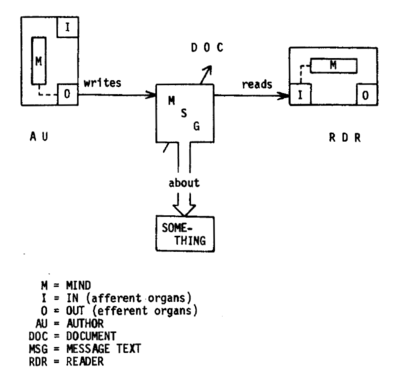
My basic model is presented in figure 1. The rectangles at either end
represent individual humans. The areas marked I, O, and M stand for the
bodily internal IN-organs, OUT-organs, and MIND, respectively. The IN-organs
are any sensor or set of sensors humans possess. For the purposes of this
paper they will be mostly the eyes used in ordinary reading, though they
could be the ears for listening to sound recordings, the fingers for Braille
reading, or whatever other body parts for whatever other means humans have
of sensing externally stored messages. The OUT-organs would be mostly the
fingers using pencils, typewriters, etc. for written documents but could be
whatever other organs that might be used in controlling body-external,
medium-fixing instruments. The MIND is the mind and for the purposes of
this paper will be assumed. Any attempts at describing it here could lead
into a lengthy and discursive philosophical, psychological, and physiological
sideshow using lots of other Greek-based words and symbols. Its assumption
is useful in what follows; its assumption is valid in many circles of the
Western tradition of cultural analysis. Neural connection between the mind
and the mind's body-internal tools is acknowledged by the broken line from the
MIND portion to or from one of the organs at the extremities.
The originating body in my model is marked AU in a traditional library
abbreviation for author. The person at the other end of the process of
transferring the stored message ls marked here in a general form as RDR,
standing for reader, but it should be understood to represent anyone
distinguishing, recognizing, and making sense of the patterns emanating from
the message stored in the document, which in general form in figure 1 is
marked DOC. The lines of communication symbolized by the single line arrows
marked writes and reads and connecting DOC to both AU and RDR can be interpreted
most generally to stand for the creation and understanding of externally
stored messages by humans, whatever the means used.
The single line arrows outside the bodies show the direction of the
external flow of the message. The use of the slanted arrow within the DOC
symbol is an adaptation of Heilprin's symbol for indicating a variable time
delay from creation to understanding through the deferred sensing that is
possible with messages of long duration. The text of the message is symbolized
inside the document as MSG. I mean by this symbolization to assert that the
document is to be distinguished from the message text, even though in the
stored form they may appear to be nearly the same thing.
Just as a document contains a message, so does a message have contents.
Although a message and its contents also may appear to be the same thing,
they must be kept distinct. The contents of the message are symbolized in
my model by another unit outside the DOC symbol. The contents, however,
do not exist inside or outside the message except through the minds of the
AU and the RDR. Grasping this aspect of symbolic communication has been a
stumbling block for some communications researchers. I symbolize the
connection here by means of a double line arrow which is meant not to imply
that it is leaving the message but to show that the message in some way
relates to its contents. Including the label about with the double-lined
contents arrow is intended to help symbolize the indirectness of this
relationship. The addition of an about arrow comes from another model of
the communication process by Geoffrey Leech [21], whose analysis is based
in part on the functional analysis of Roman Jakobson [22]. It is the only
structural change I have made to Heilprin's basic model, the rest of my
modifications being essentially changes in labels.
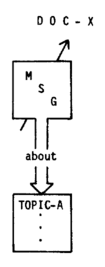
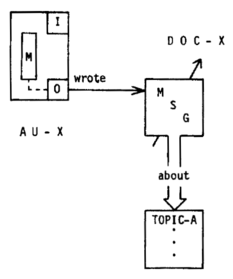
In figures 2a and 2b I have abstracted two views of a document from the
stored communication model of figure 1. The view as in 2a is easy to arrive
at from the point of view of a library or other information storage area.
The book, the journal, the film, the sound recording, even the computer
tape, is an object that lies or stands on a shelf or in a drawer, or otherwise
takes up space, and is quite tangible. With a little reflection, however,
the next figure, 2b, is not hard to keep in mind, especially with books
that emblazen their creator's name in gold or other pretty decoration on
their spines, or with the journal article whose author's designation is
displayed in generous white space just below its own name, the article's
title. The Anglo-American cataloging tradition has canonized the practice
of author recognition in its general principles for catalog entry [23, pp, 9–10].
Both figures 2a and 2b disregard the contribution of editors and
publishers to the form of the document, but the documents themselves, and
in part the rules for documentation, do make more or less explicit recognition
of at least the publisher responsible for the form of the document. Researchers
usually recognize the processes that stand between the creation of a message
and the storing of it in documentary form. They cannot but have become
acquainted with the processes as producers of some of the documents that have
come to be stored.
Perhaps this is the first part of the definition of a researcher, someone
who has created a message stored somewhere in a document, as contrasted to
searchers, persons who may have handled documents extensively but have never
gotten a message stored in documentary form. The American Ph.D. tradition
canonizes this distinction by making the granting of the research degree
dependent on the depositing of a documented message, the dissertation, in at
least one storage facility, the degree-granting institution's library, then
often to be made more generally available through on-demand reproduction,
a process with which the dissertation's author may be personally familiar
because of degree requirements to provide a copy for microfilming, to pay a
microfilming fee, and to produce an abstract of the dissertation to be used
in advertising the work to other researchers. Whatever other documents a
researcher produces — books, journal articles, and various other forms of
research reports — usually go through several stages of editing, printing,
and publishing, which themselves become very apparent to the researcher
transmitting messages through those processes.
Because researchers generally understand that there is often a great
deal of work that must be done between the time an intellectual work first
gains physical form as a manuscript by an author and then gets stored in a
library as a document, I have subsumed all the intervening processes under
the single arrow marked writes. This is not intended to discredit editing
and publishing, but only to draw attention to the creative aspect of authoring,
an aspect of research which, I believe, is not generally understood by librarians.
Librarians may have a personal acquaintance with some of the publishing
aspects of the preparation of a message for storage through their contact
with publishers and their wholesalers at the selection and acquisition stage
of document storage. The processes of library selection and acquisition may not be
well known to researchers, but the purpose of this exposition is to explain
researchers to librarians, not librarians to researchers.
One potentially misleading aspect of my model is the delineation of
TOPIC's in the contents portion of the stored message. In documents of
free text, e.g. typical books and journal articles resulting from scholarly
research, the topics discussed in the messages of those documents are usually
not so easily delineated as my symbols might suggest. I intend to use a
single enclosure around all the topics in a stored message as in figures 2a
and 2b to indicate that the topics are included within free text. Some
documentalists use the term 'natural language' for this distinction, but I
my attachment to that compo1compound's designation in the traditions of philosophy
and linguistics disallows my use of it here. The term 'free text' as I use
it is potentially misleading also. I hope the distinctions I am trying to
make here will become clearer in the later portions of the present text.
The various topics in free text may be more or less separately discernible
by a reader. The reports emanating from different traditions may lend themselves
more or less readily to mechanical elucidation of topics through the calculation
of occurrences of words. Those disciplines with rather rigid jargon and
quite stern, even ossified traditions of style in communication, e.g.
jurisprudence, secret military correspondence, may lend themselves more
easily to mechanistic text analysis, but a general method of such abstraction
of topics by keywords seems not readily realizable for the purposes of
scholarly research. The hard part of using a document for research comes in
reading its message, discerning the intended meaning, and fitting the
understanding gained from that reading into whatever else is going on in the
mind of the reader. Librarians who may or may not do a lot of reading of
separate texts may be misled on this point of topic analysis because of the
forms of messages that they deal with a great deal, i.e. indexes, abstracts,
and other condensed and/or simplified subject statements.
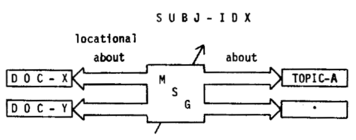
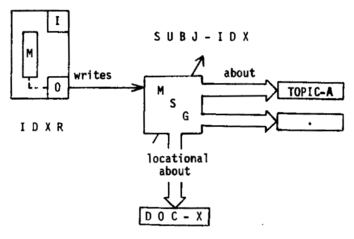
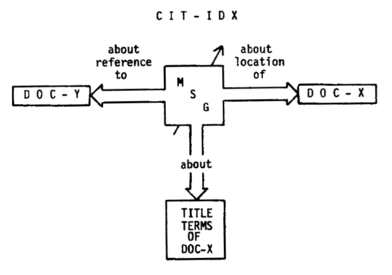
In figure 3 I have represented a static view of an index. The two-fold
array of double-lined about arrows attempts to capture the functioning of
a subject index, here meant to include many types of subject indicating
devices, e.g. the subject portion of a library's card catalog or the various
subject indexes with which the many reference librarians are more familiar
than I am. A subject index typically lists a series of short statements
each made up of a word or word group or other symbolization of a series of
topics more or less precisely selected, depending on the characteristics of
the index, and then gives clues to the location of documents whose messages
contain something about the topics so represented.
Even though I have symbolized the topics referred to by the index's
message as individual items in figure 3, i.e. TOPIC-A, etc., it should not
be forgotten that this is not meant to indicate that this is the form in which
a reference to TOPIC-A, etc., is necessarily found in the index's text, but
rather that a portion of the text of the index‘s message is about TOPIC-A, etc.
Nonetheless, indexes, with their typical unitary symbolization tend to give
the impression that TOPIC-A is the words or other symbols standing for TOPIC-A.
To understand why this is not the case, think of the very general topic
'water'. In an index, I could symbolize this with the English word water, or
the German word Wasser, or the chemical notation H₂O, or even some non-standard,
arbitrary notation such as Kg78*-444. As long as the reader of those symbols
understood the system of notation, be it common language or special symbols,
the topic would be understood to be the same. It is, however, quite easy
to forget that the reference to topics is through symbols if you use quite
frequently an index that has as its notation words from the common language.
Despite the potentially misleading character of my unitary symbolization
for topics in an index, I prefer to use it as in figure 3 for the aboutness
representation of an index's message, because enclosing each topic separately
makes a convenient, and, I believe, revealing contrast with the free text
representation I have symbolized in figure 2. It should not be forgotten,
however, that the form of the symbols for TOPIC-A, etc., is within the text
of the messages about the topics, and that the text, whether created by an
author or an indexer, only represents TOPIC-A, etc. Recognition of the problem
of fitting words or other symbols to concepts is rather basic to the use of
reference tools. Devices to aid solution of this problem include thesauri
and other means of vocabulary control.
Indexes have creators, something that readers, even librarians, too
easily forget or do not even realize. It is easy to look at the entry in a
card catalog or other standardized index and forget that some person has,
at some point in time in the past, created a message contained in that
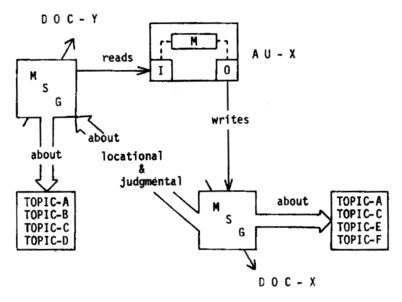
entry. A more complete view of the index, in the sense that 2b is a more
complete view of any document than is 2a, is contained in figure 4a.
Here I have included, for simplification of the diagram, locational
reference to only one document. With figures 3 and 4 it should not be
forgotten that an index may include locational reference to many more than
one document with each reference to TOPIC-A, etc. The simplification
incorporated in figure 4a is due to the representation in the next figure,
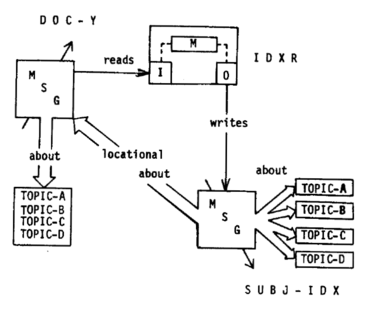
4b, which is intended to symbolize the process by which an indexer creates
a message for storage in an index about the topics of a single given document,
which, if I understand the human process of indexing, is the way its progress
is measured, document by document, even though the indexer may he working
on more than one at any one time and in the end summarizes the process by
collecting together all the documentary references to TOPIC-A, etc.
Figure 4a might have left the suggestion that the indexer just makes
up indexes out of his head, but in fact, except perhaps for spurious
examples, indexing requires some effort at examining the document being
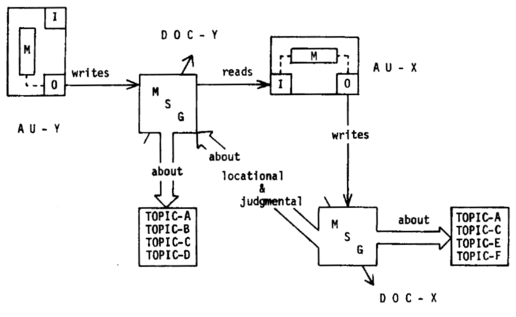
indexed, symbolized in 4b by the reads arrow. To make the communication
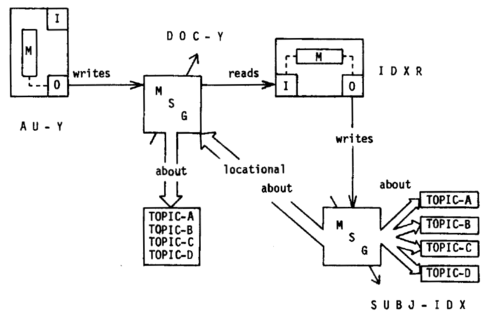
process from original author through the indexer to the stored index even
more complete, I have added the AU symbol and his writes arrow to get
figure 4c, much as I added the personal and creative symbols to get 2b from
2a and 4a from something like 3.
I think 4c is a better way to symbolize subject indexes, not only
because it is a completer statement of the processes behind their creation,
but also because it symbolizes elements related to a document that are
usually found in indexes used in libraries. Not always, but usually there
is indication of the author along with the locational information of a given
document. Other information, especially usually the document's title, is
included with the locational information. All of this documentary information
about the message being indexed could be specified more explicitly along
with the cover term locational which labels the double-lined about arrow
connecting the index message to the original document. I wish, however,
to subsume all that documentary information under the one term, and I believe
it will not be too misleading to do so. Generally, indexes are pretty clear
in references to documents and their locations. although the actual practice
varies and can be confusing, e.g. In the use of abbreviations for 'well-known'
journals.
In figures 4b and 4c the contrast between the message texts of researched
documents and the simpler texts of indexes referring to them, utilizing
the symbolic variations for the representation of TOPIC-A, etc. as discussed
above, becomes important. Say that a person is searching for material on
TOPIC-A and has stumbled onto or been guided by a librarian or other
resourceful person to an appropriate subject index symbolized as in figure 3
or one of the variations of figure 4. Suppose that such a searcher has
correctly discerned that the message of the subject index contains reference
to TOPIC-A as being located in DOC-Y. Following from this there is a naive
view that when our searching person gets to DOC-Y he should quite easily
locate the portion of DOC-Y that refers to TOPIC-A, and, most naively,
should also find there in the text of DOC-Y the words which the searcher
found in the text of the index's message used for describing TOPIC-A.
I think what I have described as a naive assumption about message texts
is quite common among persons not having much experience in scholarly
research, which may be another way of saying not having read a lot of free
text in depth about a topic, a possible step in defining a scholarly
researcher, by saying what he is not. It may well be that certain texts
or types of texts allow for a simpler minded searching approach. Such
may especially be the case with documents meant to serve fact finding.
Fact-finding information gatherers may look at their index map and go into
the library woods tn gather their information berries, but that is hardly
an adequate way to describe a vast portion of scholarly research.
Scholarly research does include writing and reading, but it also
demands thinking. Subject indexing meant to serve scholarly research must
also include some thinking. This aspect of indexing is symbolized as a
potential of the MIND portion for the IDXR in the variations of figure 5.
Finding reference to DOC-Y in a subject index is only one way of getting
to DOC-Y. Another way to get there is to come across DOC-Y directly, which
may appear to he harder to do than to go through the subject index, especially
if the reason for getting to DOC-Y is to find something about TOPIC-A.
However, knowledgeable researchers do have other means, a large number of
which involve indexing of some kind, although it may not be the kind that
results in a stored message of the type found in a subject index.
Shelf arrangement is a well known device for indexing and retrieving
documents by means of general classification. Browsing is a well discussed
topic and is also a functioning part of my method of research. However,
browsing, in its most productive form, which I would prefer to call shelf
searching, is an active process that depends on the searcher having done a
lot of reading before going to the shelves, although not necessarily
immediately before, and also some careful reading while at the shelves.
Thinking is also very much involved, and so may be writing, to the extent
at least of making small notes if, for example, the active shelf-searcher
comes across a document he cannot take along at the moment.
In addition to external classification devices, an active researcher
has categorized in his mind the journals, publishers, books, etc., that
are likely to have material about TOPIC-A, if indeed the researcher is
familiar with that topic as a part of his discipline. As the reading,
thinking, and writing of a researcher intensifies, and perhaps also broadens,
the researcher becomes very expert, not just about TOPIC-A, but also about
the form of documents, and, most importantly. about specific documents
that have discussion of TOPIC-A from several points of view.
Different researchers may employ very different and very idiosyncratic
methods of keeping this documentary information in their files and/or minds,
but it is generally true that an advanced researcher has well developed
means of keeping tabs on what is published or being published about the
topics in which he is interested.
I do not intend here to describe elite groups of highly paid researchers,
such as those in medical, space, and secret intelligence fields, who are
given what seems to an outsider as unlimited funds, part of which they can
spend to develop elaborate electromagnetically interconnected retrieval
devices using gross operations of mindless machines. Those researchers
have their own methods, including a lot of yes-men-and-women to carry out
factory-like information assembling tasks. With large numbers of people
and machines between researcher and message store, different things happen
than with a more or less independent researcher who goes more or less
directly to the stored message.
I intend to describe here also more than just the elite groups of
researchers commonly known as 'invisible colleges'. What is designated by
that phrase, which has been used as an appellation in English speaking areas
for more than three centuries, is the very personal way that rather select
groups of individuals have of keeping each other informed of what they and
the other 'important' people are doing. Members of an 'invisible college'
are usually highly visible to anyone who has followed a particular discipline
that can be said to have an 'invisible college'. Only their privy secrets
remain unseen beyond the fold until someone decides to display them in public.
Usually there is enough leakage to enable anyone exerting a little effort
to figure out generally what is going on within the group.
I mean, in addition to members of the visibly elite, to include among
scholarly researchers the common garden variety Ph.D. holder who reads a
lot, thinks too, and writes, although maybe he does not get what he writes
into 'documentary' form very often. Such people abound in colleges and
universities across the United States. The largest portion of their writing
may be in the form of lecture preparation notes and as advisory notes to
term papers and/or tests from students in classes they teach. These people
are not so highly visible on a national scale as are the members of the
‘invisible colleges', but they can be observed in lots of places, essentially,
or hopefully, wherever there is an institution that considers itself one
of the academies of higher education. The names and credentials of some of
them can he found listed in the various volumes published under the Jacques
Cattell imprimatur, e.g. Directory of American Scholars, American Men and
Women of Science.
In a way, this very large group of certified researchers provides,
through the courses they give and the relationships they develop with students,
a very valuable link to the research that goes on nationally. These academic
leaders form the final funnel for much of the information of a 'higher'
nature that trickles down to the students in such academies. This is
especially so if, as I think to be the case, many undergraduates read very
little, and then only what has been assigned by their instructors. Because
this group is readily perceptible, if one only looks in the right place,
but also because the individuals in this group are not so clearly distinguished,
a designation for them as a whole may well be 'the translucent college'.
These very important people do read a lot and arrive at documents
through other means than through subject indexes supplied by librarians
and other information handlers. The kind of independent researcher I have
in mind may well get to a document through reference to it in another
primary document. As many user studies have shown, this is quite commonly
the way an experienced reader follows a topic through documents, especially,
I believe, the reader conducting research, hence doing a lot of reading.
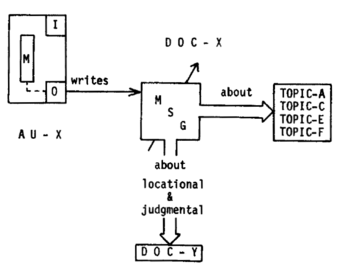
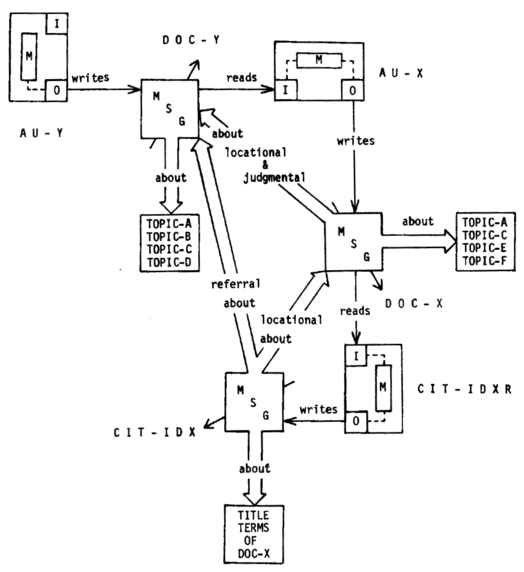
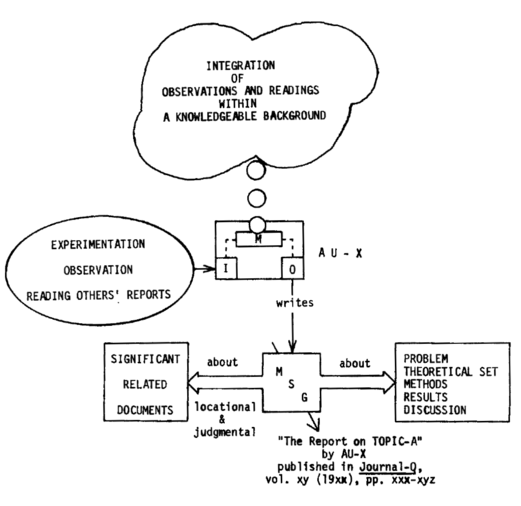
In the three figures of 5, I symbolize the writing, reading, and
referring research processes once again based on the Heilprin-Eichman
model of stored communication. As before, I show the various states of
completeness of view of the processes of reading and writing. Figure 5a
already has an author symbol attached to a new DOC-X, which contains
reference to DOC-Y. Figure 5b adds the reading that AU-X must do to be
able to make reference to DOC-Y, and 5c completes the picture by designating
as AU-Y the originator of the message contained in DOC-Y and used by AU-X.
Notice the outward similarities between the models of the indexing
process in in 4a, b, and c, and that of the process of authoring in 5a, b, and
c. Notice that both in indexing and authoring a person writes a new
message that refers to his reading of DOC-Y. The referral to the location
of DOC-Y within the text of each type of document, in the index and in the
second document, DOC-X, will be fairly similar in form, since participants
in search and research processes, indexers and authors, more or less agree
on style of documentary reference. However, the message of DOC-X will often
differ in its reference to DOC-Y in a way very fundamental to the research
process from the standpoint of a person wishing to read DOC-Y for further
research. As indicated with the inclusion of the phrase judgmental along
with locational on the double-line about arrow connecting DOC-X to DOC-Y,
there is, more often than not, I believe, either an implicit or explicit
value judgment made about an original document in the message of another original one citing it.
Another important difference between a subject index and a referring
document as with DOC-X is the manner in which TOPIC-A is dealt with in the
text of each. As we have seen before in discussing the representation of
the references to topics found in indexes, it is easy to view TOPIC-A as
the words that stand for it in the message text of the subject index. In
whatever way it is that an indexer decides that DOC-Y contains something
about TOPIC-A, he will generally symbolize it with a concise symbol or
group of symbols. When one looks at the text of DOC-Y, one may or may
not find the symbol or group of symbols the indexer has used to symbolize
TOPIC-A. If the indexer has done a good job, then other people reading
DOC-Y will agree that it contains something about TOPIC-A. To prove the
thoroughness of the indexing of DOC-Y, one has to find agreement that
in addition to something about TOPIC-A there is also material about TOPIC-B,
TOPIC-C, and TOPIC-D in DOC-Y, i.e. all the subject statements the indexer
has assigned in indexing the document.
A simple-minded searcher coming to DOC-Y looking for something about
TOPIC-A and coming across material that is about the other topics as well
may think that the indexer has done a sloppy job of categorizing the text
of DOC-Y, a trap I often find myself falling into on those few occasions
when I use a back-of-the-book subject index in a book in one of my specialty
fields. A less simple-minded view would acknowledge that TOPIC-A is
included in DOC-Y along with the other things found discussed there and
would assume, or at least would probably hope, that the indexer had seen
the total picture also and had captured the essence of the document with
the topic statements he chose. I believe that a lot of people who use
subject indexes as their main tool for access to research literature do
hold a more simple-minded view similar to the naive view of representation
I have described above.
In figure 5c (and 5a and b also) I have symbolized the contents of
DOC-X with different topic statements than those for DOC-Y, oversimplifying again the aboutness
relation of the text thereby, but also hopefully stressing the difference
between a second, referring document and an index. The difference in form
between topic statements in the document's text and the index's text is
indicated by enclosing the topics of the second document within one
rectangle as a message unit as opposed to the separate rectangle for each
topic statement of an index as in figure 4c. It might be good to recall
at this point the static view of the subject index as in figure 3. A
subject index covering both DOC-X and DOC-Y would list all the topics in
both documents and make references to the appropriate documents with each
topic reference. In the case where there is sharing of topics, e.g. TOPIC-A
TOPIC-C, the index will make reference to both DOC-X and DOC-Y with each
shared topic.
In figure 5c I have indicated that DOC-X contains text about TOPIC-A,
TOPIC-C, TOPIC-E, and TOPIC-F. I could have shown an example with the
same topic list for DOC-X as in DOC-Y. Indeed, different authors sometimes
write about the same kinds of things in much the same way, perhaps making
just some fine distinction between them, a distinction unimportant to
general subject indexing but perhaps very important to the researcher.
However, authors also write their own messages about the world and often
include only some of the same topics that someone else has covered in a
document they have read. The resulting dispersal of topics may cause
scatter headaches for the librarian who likes to keep every topic neatly
filed, but such a state of affairs cannot be avoided without a stifling
regimentation of research.
I symbolize different topics for the two documents in 5a, b, and c,
as I believe that case is more typical than completely co-extensive
documents, or at least so it might seem to a researcher who is not required —
as is the indexer as part of his job — to say in a few short statements
what the topic of a given document is. What the researcher does when he
authors an document is say what he wants to say about whatever topics he
is currently writing up. In doing so he may make reference to previous
work in the same area, more or less well defined.
When a reader uses DOC-X, he will not necessarily find TOPIC-A
covered first, then TOPIC-C, next TOPIC-E and finally TOPIC-F. He will
no doubt find a coherent text that might or might not be separable into
sections relating to those topics. Nonetheless, if DOC-X is related to
DOC-Y through inclusion of material about TOPIC-A, then when the portion
of the message of DOC-X is more or less about TOPIC-A, there might well be
explicit locational reference to DOC-Y, and not just to ways of finding the
general location of the document, but also, in many professional scholarly styles,
to the specific portions of DOC-Y that refer to TOPIC-A, although the style
and extensiveness of citation varies from author to author, from academic
discipline to academic discipline, from journal to journal, and from publisher
to publisher.
Primary document reference can be more valuable than the usual
general subject index reference for someone interested in reading about
TOPIC-A because it includes textual reference to TOPIC-A in two documents
that include discussion of the topic in and among discussion, on the one
hand, in DOC-X of figure 5c, of TOPIC-C, TOPIC-E, and TOPIC-F, and on the
other hand, in DOC-Y, among discussion of TOPIC-B, TOPIC-C again, and
TOPIC-D. Because of the nature of the texts of researched academic
messages, all of these topics are probably well related in one way or another.
Finding topics discussed this way in st least two documents will probably
help the researching reader zero in on TOPIC-A from a wider standpoint
than the simpler-minded, 'What are the facts about TOPIC-A?'
Furthermore, because researched articles usually contain reference to
more than one other document, a whole network of citations related in some
way to TOPIC-A may open up to the reader who stumbles upon or is directed
to at least one such document. Such a network of citations is what makes
the citation indexes from Philadelphia work for the researcher, about
which topic more below. Citations only work, however, for the document
user who is interested in following up on and reading whatever references
are made by the document's author. Not all other works cited will be
directly useful, but they will at least help provide an understanding of
what point the author doing the citing is trying to make. Understanding
the background of an author's claims so that an evaluative judgment can
be made is a key aspect of critical research. Critical research involves
much more than the fact finding that a popular view of science seems to
hold as representative of scientific research.
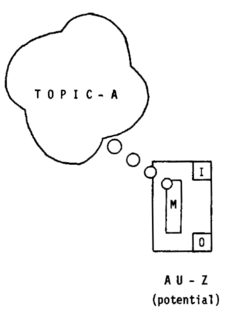
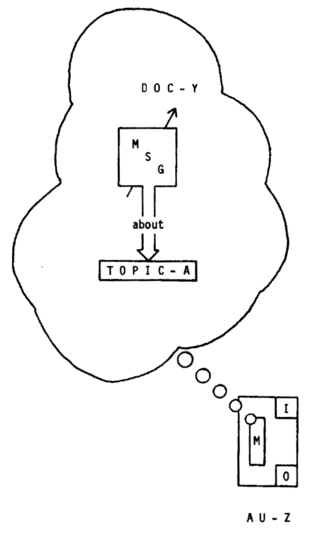
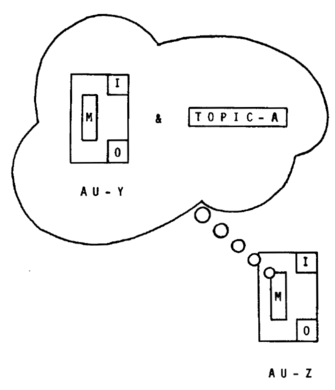
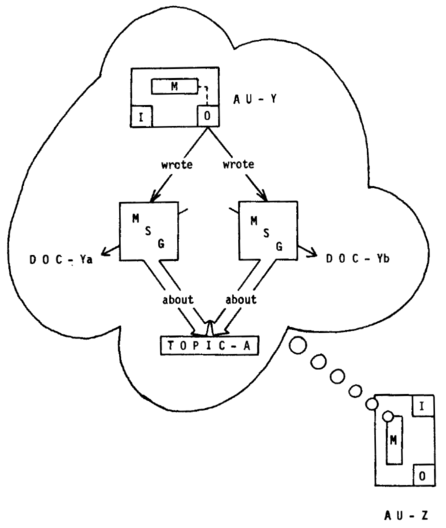
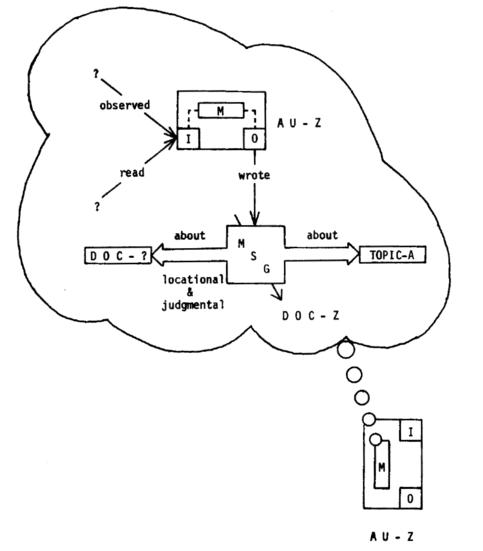
Now suppose again that we have a person searching for some material on
TOPIC-A. We can symbolize this person as in figure 6, where I have tried
to indicate through use of a conventional cartoon device that this person
has TOPIC-A more or less in mind. How he got to that hazy condition is a
fact of his life. This person is now wanting to find something he can
read about TOPIC-A, that is, he wants to make connection to his IN-sensors
that will bring some information to process inside his mind along with his
foggy notion about TOPIC-A. I assume further that this person, after
reading about TOPIC-A, intends to, or is required to, if possible, control
his OUT-organs and create a message potentially for storage, which will come
to be known as DOC-Z. It is for this reason that I have labelled the
personal symbol in figure 6 AU-Z (potential).
If this person is unfamiliar with the primary literature concerning
TOPIC-A, he may go to a subject index, which he perhaps views at this point
as a static device as in figure 3, scan its list of subject statement entries,
and, assuming he can match his more or less foggy notion of TOPIC-A with
some entry on the list, be led by the index to DOC-Y. When this searcher
gets to DOC-Y, he will then have the problem of finding relevant discussion
of TOPIC-A, which, depending on the topic and the document, may be more or
less easy to do, as discussed above.
This same person symbolized in figure 6 may have come across DOC-X,
perhaps by accident in the current periodicals section of a library, in
which case it may well not be indexed in a standard index yet, or he may
get to DOC-X through other means, conventional or non-conventional, including
even perhaps through a subject index in the manner described above, if
enough time has elapsed since DOC-X was published, if it was published.
No matter how he gets to DOC-X, as symbolized in figure 5c, there he will
find a citation to DOC-Y much like what he found also in the subject index,
i.e. with indication as to where to locate DOC-Y. He will also probably
find in DOC-X a wider discussion than what might be narrowly associated with
TOPIC-A (as discussed in the previous section in connection with figure 5c).
Now if potential AU-Z is conducting research, which may include fact
finding but also requires more thinking, he will probably appreciate and
benefit from the discussion of TOPIC-A that he finds in DOC-X. He may
disagree or agree with AU-X, but at any rate he should appreciate having
reference to another text created by another author concerned with TOPIC-A.
Indeed, if this person were conducting only a fact finding search, he may
be satisfied with what he finds in DOC-X and not wish to look further into
DOC-Y except perhaps to see whether AU-Y agrees with AU-X, something he may
already know from having read DOC-X's judgmental reference to DOC-Y.
Checking back on cited sources is a rather basic aspect of research
which graduate students are normally expected to know about. Again Morton
Fried's guide to the study of anthropology states this aspect well. In a
discussion of the evaluation of papers written by prospective graduate
students, Fried says,
. . . there is increased expectation that statements will not be
taken as fact simply because they appear in print. Graduate papers
should display a critical attitude toward the information used; they
should reveal the interest of the student in the methods used to obtain
the original data, and some curiosity about the logical tools employed
in manipulating them. One expects to find an awareness of theoretical
sets, whether apparent or latent. In other words, graduate students,
much more than undergraduates, must show sophistication in assessing
the biases that produced the work on which their papers rely. [Fried
digresses briefly to assert that undergraduates also can make critical
judgments, and then he continues.] One way of accomplishing this, as
suggested earlier [cited above], is to do research [emphasis Fried's]
on the critical statements found in the work of others that supplies
the main basis of the paper in question. This means digging into
learned journals to find reviews or critiques of that work, checking
out the author's sources, trying to find other accounts of the same
phenomenon. Even if the student lacks the expertise needed to make
an authoritative decision about truth, it is possible to indicate
the basis for acceptance or rejection of the statements in concern.
[18, pp. 196–197]
What Fried is describing is partly the rites of passage from student
to researcher, perhaps also from searcher to researcher. It is no linguistic
coincidence that one way a person can come to be considered an authority
is to author something. To become a published author, one has to accept
careful scrutiny of the text of a message one wishes to send to the world.
Part of this scrutiny one does himself as a part of the research in preparation
for formulation of the final text. The checking and verifying described by
Fried is an essential part of that research. Researchers may use a subject
index as a guide to that research, but usually, I believe, only, if at all,
in the early stages of research for getting started and perhaps then later
to do some looking anew at the topic of research in an attempt, as Fried
says, "to find other accounts of the same phenomenon" after already having
formulated a definite opinion.
Both the researcher and the indexer must read and understand the
message of a document they are dealing with in order to be able to fulfill
their professional tasks, allowing, of course, for the normal misunderstanding
that occurs in the course of human events. But what the researcher and the
indexer each does with the understanding of a text are quite different
things. This difference is stated well in a philosophical tradition concerning
the understanding of what philosophers like to call the proposition of a
statement, what we might call the 'aboutness' of the message texts in our
context. The philosopher G. E. Moore made a three way distinction in what
a person can do after understanding a proposition — believe it; disbelieve
it; or neither believe nor disbelieve but simply understand it. [24, p. 56]
The researcher in the present analysis has at least the first two
options and may even exercise the third, suspending judgment until further
research can allow him to make an evaluation.
The indexer's professional role allows him only the third option.
His task is to construct a device to point accurately and meaningfully to
whatever document he is indexing. As a critical person, the indexer may
exercise either of the belief options, but his professional duty requires
him to create a simple message that fairly represents the contents of the
document's message text through his understanding of that message.
It may well be that an indexer with a less personally committed view
of a text can perform a more efficient job of simply understanding the
text and representing it with general subject statement indicators than can
a committed researcher. That is to say, subject experts may not be detached
enough from a field to make the simple understanding required in indexing.
I do not mean simple here in any pejorative sense, because having to do a
quick read of a long or short, more or less dense text and then come up
with a short statement or series of statements giving good indication of
the contents of that text is not a simple task. The simplicity is even
less apparent when one realizes that an indexer performs such a task on
several texts each working day for perhaps many years. The individual
task with each text is just less complex for the indexer than for the
researcher who must make that text and its contents fit into everything
else he knows about the perhaps very narrow TOPIC-A. The latter requirement
is the critical review which is a part of the research process.
Librarians who deal with documents as individual item are less aware
of the internal connections because of the lack of a requirement to deal
professionally as believing or disbelieving whatever is contained in the
text of the document's message. Such detachment from the contents of a
text leads, I feel, to the view of the inherent separability of text and
references that I criticized at the outset. The uncritical attitude is
carried to an extreme when librarians and other information handlers worry
that citations may be to other works that an author wishes to refute, thus,
I guess, making the information handler's analysis of citation practices
less than an ever upward, positive and progressive view of the development
of knowledge. [12, p. 309]
I sense among librarians an attitude toward written works that is
reminiscent again of Fried's description of the undergraduate student
who has not as yet developed critical abilities, and perhaps never will:
Students sometimes take the position that a paper deserves the optimum
grade if it does not contain factual errors. Further, it is felt that
such errors are unlikely if the paper was based on many seemingly
highly regarded books. Viewed that way, the main point of a research
paper is missed or distorted. [18, p. 116]
Fried describes an attitude I also have found in papers of many of the
undergraduates I have taught. I believe that underlying this attitude,
and the uncritical attitude I find in many librarians, is some kind of
belief in the existence of an independent authority that deems whatever
is in print to be the God's or gods' truth. In truth, the research gods
are the mere mortals who are creating the message texts that get published.
The veracity and validity of their statements are ascertained only by the
continual close and critical scrutiny of those texts.
It is because of the interconnection between texts that is revealed
through citations that citation indexing can provide a means of finding
documents on specific topics. It is because of the lack of understanding
of the nature of research going into the preparation of scholarly academic
texts that the importance of citations to a researcher is often misunderstood,
primarily, I believe, by librarians and others uninitiated in the critical
attitude required for research. Viewing citation indexing through the
model that I have used in analyzing the processes of subject indexing and
authoring in figures 4 and 5 should help explain also how citation indexing
can produce a product useful to the researcher.
With figure 7 I have added the representation of a citation indexer
and his processing and product to the model from figure 5c. I have not
taken it through stages, as with 4a, b, and c and 5a, b, and c, for two
reasons. First, my reader by now should be able to follow the diagram in
figure 7 based on his having plowed through my material up to this point.
Second, citation indexing is not a very creative process in itself. The
reading and writing required for it are much more elementary than those
processes required for authoring and perhaps for subject indexing.
Citation indexing lends itself much more readily to mechanical
processing than subject indexing because it mostly, if not entirely, copies
and/or systematically reduces the citational and title information of the
work being processed. Whatever reduction is possible depends on the redundancy
that is a very important feature of the communicative potential of language.
This kind of indexing is essentially a parasitic process that depends for
its simple success on the creative activity of an original author in
selecting a title for his own document and in making careful reference
notation, including locational information, to other documents. Citation
indexing's parasitic nature is revealed quite directly in a suggestion
made by Eugene Garfield of a project for library school students. [25, p. 399]
The three types of indexes to research literature provided in the
series from the Institute for Scientific Information, the source index,
the citation index, and the permuted title term, or quasi-subject index,
arc produced by ripping off and redisplaying the externally appearing
components of an author's text, the title and the reference citations.
These portions of the document's text, when their connections to other texts
are shown as they are in citation indexing, can be very useful to a person
initiated in doing research, especially to one who is familiar with the
topics covered in those texts and with the authors and/or works of the
authors doing the citing and being cited.
Once again contrasting a static view with the view presented in figure 7
may help clarify the difference in attitude that librarians and researchers
might have toward citation indexes. A view as in figure 8 is what people
uninitiated in research may very well have and may be a quite common and
understandable way for any user to approach citation indexes.
Each time I go and pick up one or the other volume of the ISI series
I have to stop and think about what I am doing in trying to find something
there. I have trouble remembering, if I have not used them for a while,
whether the source or the citation volume is where I want to look. Trying
to remember by attaching the label 'source' vs. 'citation' in my mind does
not always help, because my experiences with these valuable tools have shown
me that I can find leads for my research in any of them. Once I get started
in one, my knowledge of research processes and of the subject field I am
working in allows me to thread my way to useful references through all three
of them. The permuted title index is probably the least confusing of the
three, because titles are used quite widely as clues to the contents of
documents. The older central European cataloging tradition known as the
Prussian Instructions made use of rules for the selection and control of
content words of titles as a means of subject access a long time before the
incorporation of the institute in Philadelphia.
The potential confusion between source and citation is well symbolized,
I believe, in the static view of figure 8. The connections between the
text of the citation index's message and both of the documents that are
internally connected to each other are of the same character. That is to
say, the message that the citation index conveys is that located in DOC-X,
itself located at such and such a place, is reference to DOC-Y, which itself
is located at such and such another place. The message of the citation
index simply interconnects locations of texts which the author of the most
recently produced one of them thought were somehow related. There is no
attempt by the citation indexer, beyond repeating and in part juggling
around the titles of the interconnected documents, to tell a potential
reader of the citation index's message what the processed documents' topics
are.
The processes of citation indexing contrast greatly, from the standpoint
of the intellectual processing required, with the service the subject
indexer provides when he reads portions of the text of a document and, in
addition to repeating locational and title information, makes an independent
decision about the topic content of the document's message and represents
that content, as he views it, with a new subject statement, in effect writing
another symbol or string of symbols, or even several, much like what the
author has written as a title. In fact, the author may also have written
other such subject statements as headings of sections and sub-sections of his document.
The clever subject indexer may even take advantage of these sub-headings
in writing subject headings as part of the indexing process and thus also
be more or less parasitic like the citation indexer.
The differences that do exist in the requirements for processing of
subject vs. citation indexing may be well understood by librarians, but
the value of citation indexing to researchers is underrated by librarians,
partly, I believe, because of the intellectual commitment subject indexers
have to subject indexing and partly because of the librarians' failure to
grasp the intellectual commitment that researchers have to their research.
Perhaps hypothesizing a potential user of citation indexes, as I did above
with figure 6 for a potential user of subject indexes, will help provide
an understanding of the usefulness of citations to experienced researchers.
For the hypothesized potential user of citation indexes I use the
personal symbol I have used before but this time label him AU-Z. For these
examples I assume that this is an experienced researcher, most obviously a
person who has authored at least one researched document, e.g. the holder
of a Ph.D. for which the person has produced a dissertation. This is not
intended to suggest that all researchers must have Ph.D.'s. A researcher
should be understood to understand what Fried says a graduate student must
understand.
A researcher who is committed to a more or less narrow field can
approach indexes with more in mind than the foggy notion of TOPIC-A as
symbolized in figure 6. Indeed, researchers have probably categorized in
their minds lots of rather hardened notions about certain topics. But our
symbolic researcher will be assumed to be coming to an index with something
open in his mind about TOPIC-A.
In his mind the researcher might have associated with TOPIC-A a certain
document in which he has read about that topic. Figure 9a represents what
AU-Z may thus have in mind where DOC-Y is the document he remembers having
something about TOPIC-A in it. He may go to the citation index, viewing it
as in either figure 7 or figure 8, and find there that DOC-Y is referred to
in DOC-X, which we know is the result of AU-X having read DOC-Y and having
referred to it within the text of the message he has written for DOC-X.
The citation index tells AU-Z where to find DOC-X, or at least gives him a
start on that path, and, if he does not remember, how to get back to DOC-Y
also.
I believe that the situation described in connection with figure 9a
is, however, less typical than the way a researcher would usually approach
topics through a citation index. More typical, I believe would be either
of the situations represented in figures 9b and 9c.
Figure 9b represents the association in a researcher's mind between
a certain topic and another researcher, whom he may know personally, whom
he may have met as a graduate student or later at disciplinary conferences
and/or other colloquiums, or however it may be that researchers come to
know personally the other researchers interested in their narrower fields
and with whom they may eventually form their own 'invisible colleges',
by which means they keep their interpersonal communication private for a
period of time.
A less directly personal, though equally strong attachment in an
independent researcher's mind may build up just from having read a lot
of the documents that a like-minded researcher has authored, in whatever
form they might be, overt or covert. Such practice may even lead the
researcher to imagining what the person being read must be like. In the
field of linguistics there is a well-known anecdote demonstrating mistaken
assumptions scholarly researchers can make about others whom they know only
formally through reading their documents. In this instance, an older colleague
had vastly overestimated the age of a younger man, whom he asked, when they
met, if by chance the younger man were related to the famous scholar, himself,
in fact. [26, pp. 2–3]
The more formal, though also quite personal association in the mind
of one researcher for a connection between another researcher and a topic
through documents the second researcher has authored may be better represented
by figure 9c. I have included here more than one document for the remembered
author, AU-Y, as I believe that this is the more typical situation in the
formal kind of personal relationship to researchers and their documents
that I am talking about here. AU-Z in figure 9c has two definite places to
start from in a citation index, which, if AU-Y has written two actually
different documents dealing with TOPIC-A, might lead AU-Z into a somewhat
overlapping but potentially very finely discriminating analysis in the
literature of TOPIC-A. The references within the references lead to still
other references, and AU-Z becomes faced with the old familiar problem of
when to stop looking at references.
AU-Z probably knows the territory of TOPIC-A, because he is probably
somewhat of an authority in it himself. The knowledgeable researcher can
fill in from his prior research some or all of the things about the original
documents he has read, which could be symbolized as in figure 5c, and beyond
even what the citation indexer copies, as symbolized in figure 7. Because
of this research knowledge, figure 8's view of the citation index fails to
represent what the researcher can read into the information he finds in
the citation index. In fact, it is a distortion to leave figure 9c in
isolation as representing what the researcher knows about TOPIC-A.
Assuming that AU-Z is a published authority on TOPIC-A, he probably has
in his memory some kind of representation of at least the elements I have
symbolized in figure 10. The question marks at the end of theobserved
and read arrows leading into the memory's representation of AU-Z's production
of DOC-Z have the potential of leading back to all the experiences that
have gone into AU-Z's development leading up to the document. The question
mark at the end of the locational and judgmental about arrow represents
all the documents which AU-Z actually referred to in the document he produced,
two of which might have been DOC-Ya and DOC-Yb of figure 9c, though it does
not necessarily represent all that AU-Z has read, only those documents he
cites.
I leave what is represented by the question marks in figure 10 unspecified
because trying to symbolize a typical example of a research article in this
display could result in a diagram for AU-Z's memory even more complex than
those diagrams in citation analyses that merely show the general interconnection
of journals in a discipline resulting from calculating the actual references
that research authors of the discipline have made, e.g. [27]. In addition,
the researcher's memory for the experiences and documents may be more or
less clear, depending on closeness in time and interest and other factors
affecting individual memories, and the question marks are meant to suggest
also the possible haziness of memory.
Human memory is thought to involve structures that are somehow associated
or interrelated to each other in rather startling but somewhat predictable
ways. This is not the place to go into all the details of the controversies
in those disciplines concerned with human memory, but a couple of lines of
research in the field seem fruitful as lines of inquiry for the explanation
of memory operations of the scholarly researcher.
In the areas called human information processing and, more recently,
cognitive science there are working hypotheses concerning a two-fold principle
to the structure and operation of human memory. These two aspects have
been labelled by one researcher, Endel Tulving, episodic memory vs. semantic
memory. In the work where he put forth his hypothesis, and which can serve
as the starting point for anyone wishing to cycle into the literature on
the subject, Tulving defines these two aspects of memory as follows, "Episodic
memory refers to memory for personal experiences and their temporal relations,
while semantic memory is a system for receiving, retaining, and transmitting
information about meaning of words, concepts, and classification of
concepts." [18, pp, 401–402]
There is not agreement among researchers on human memory about Tulving's
hypothesis. For example, one author finds it "questionable whether a
distinction based on anything as subjective and phenomenological as personal
reference is either viable or appropriate," and claims further that because
"all memory is surely based ultimately on personal experience, it is hard
to see what is gained by assuming different memory stores depending on
whether the personal reference is or is not recalled." [29, pp. 317–318]
Another researcher reports thinking
. . .that semantic memory really is a misnomer and furthermore that
the distinction between semantic memory and episodic memory is wrong.
Once lexical memory is separated out, the resulting conceptual memory
is basically episodic in nature. Definitions of words are part
of lexical memory. Consequences of events involving concepts are
part of episodic conceptual memory. Associations between concepts
are limited to the way concepts can relate within complete action-based
conceptualizations. Supersets are mostly artificial constructs with
definitions in lexical memory and without a place in the episodic
conceptual memory. [30, pp. 263–264]
Despite the lack of consensus on the structure of human memory, Tulving's
view is useful in discussing the memory of the scholarly researcher.
Traditional documentation with its two way split of subject vs.
descriptive cataloging or indexing may reflect the hypothesized two part
storage principle in human memory structure. The contents of the message
of a document, the topic, the subject, the semantic interpretation —
whatever you want to call it — carries the meaning of the message that
the author has created. The externals of the document, e.g. its publication
date — a temporal notation — its location, and especially the reference
citations, carry traces of some of the episodes in the researcher's life
as he went about creating for himself, by means of reading, observing, and
talking to others of a like mind, the knowledge stored in his mind and which
stands behind the authoritative documents the researcher produces.
A seemingly simple external bit of locational information, e.g. the journal
in which an article is published, the conference where a published paper was
read, or the publishing company which has put out a book, can be a trace to
the author's memory of writing, getting into pretty form, submitting, receiving
back from an editor, rewriting, resubmitting, proofing, quickly mailing hack
corrected proofs even though feeling he could still change a paragraph here
and there, finally proudly seeing the intellectual work in print, and distributing
preprints and reprints therefrom to like-minded colleagues, perhaps with
accompanying notes explaining his more recent thoughts, which might be the basis
for more communication and further publication. With a conference paper, the
author may have had the opportunity to discuss it immediately with other 'authorities'
present listening to him. An author might be reminded of these processes,
in addition to the semantic contents of his published messages, each time he lists
the simple externals of title, location, and date of his works on a résumé or
grant proposal or each time he sees such a citation to a document of his made
by someone else in one of their documents. The processes of creating intellectual
products through scholarly research are not simple. They are also often very
lonely processes, visible to no more than a few of the author's inner circle
of acquaintances, formal or informal.
The memory for and critical attitude toward one's own carefully constructed
creative works are not unique to the scholar; they are shared by skilled
craftsmen. In an interview taped and transcribed by Studs Terkel [31], a
stonemason reports his attitude towards external structures he has built:
There's not a house in this country that I haven't built that I d0don't
look at every time I go by. (Laughs.) I can set here now and actually
in my mind see so many you wouldn't believe. If there's one stone in
there crooked, I know where it's at and I'll never forget it. Maybe
thirty years, I'll know a place where I should have took that stone
out and redone it but I didn't. I still notice it. The people who
live there might not notice it, but I notice it. I never pass that
house that I don't think of it. I've got one house in mind right now.
(Laughs.) That's the work of my hands. 'Cause you see, stone, you
don't prepaint it, you don't camouflage it. It's there, just like I
left it forty years ago.
The modern scholar's writ is not set in stone, but what he has committed
to printed publication is quite permanently set in type and correctable
only with later publication, if at all. The scholar's published products
are also always on public display much like the stonemason's products are:
My work, I can see what I did the first day I started. All my work
is set right out there in the open and I can look at it as I go by.
It's something I can see the rest of my life. Forty years ago, the
first blocks I ever laid in my life, when I was seventeen years old.
I never go through Eureka — a little town down there on the river —
that I don't look thataway. It's always there.
When I go into a library I have never been in before, I find it hard to
keep from 'looking thataway' — looking to see if the library carries the
journals in which my first public pieces of scholarly work are printed and
perhaps to look at the actual works with pride once again even though I know
there are some small things I might change in them.
I can well imagine that a librarian doing original cataloging cannot
come across one of the cards in the catalog which he has prepared and which
represents the end product of a solution to a particularly difficult cataloging
problem without remembering some of the details of that problem and its
solution and reflecting with pride on the card as it exists as a trace of
those intellectual processes, even though few people, if anyone else, will
know who is responsible for it and what all stands behind its production.
Individual human memories vary, and the ability to recall the things
and processes I symbolize for the scholar in figure 10 is not always easy
to tap. Societies without external storage devices usually have an oral
tradition of cultural transmission conducted by a limited number of persons,
chosen perhaps because of their memory abilities, whose main function in
society is to recall and help preserve the society's tradition. The next
step in cultural. development includes using some external device to record
the knowledge that is so hard to recall from internal storage. Societies
that develop writing also usually develop an elite class, sometimes called
scribes, whose main duty is to record the received wisdom and/or knowledge
of the society. The tradition of recording knowledge externally has been
developed over a long period of time in and among various cultural and subcultural
traditions. One of these traditions is the scholarly research
tradition, which itself has many subtraditions in the manner of recording
knowledge.
With figure 11 I have attempted to symbolize a research author creating
a message reporting an experiment and other observations within a tradition
that calls for the message to be laid out in a topical format to include
discussion of the problem, the theoretical set of the researcher, the
method of experimentation and/or observation used, the results of applying
those methods, and a summarizing discussion with indication of possible
implications and further applications. The formatting of research reports
may be an informal, though well practiced tradition in some scholarly
disciplines, or such a format may be canonized in individual journals as
part of the code of instructions to contributors, e.g. "Organization: In
general, the background and purpose of the study should be stated first,
followed by details of the methods, materials, procedures, and equipment
used. Findings, discussion, and conclusions should follow in that order.
Appendices may he employed where appropriate." [32]
One of the reasons for structuring reports of research within a certain
tradition is to allow like-minded researchers interested in the research
being reported on to be able to judge the report through reconstruction of
its background in their minds from reading the report and relating it to
whatever else may be in their minds. Thus one of the author's reasons for
structuring his report as he does is to attempt to communicate his findings
most meaningfully to others. Another reason for structuring a research
report may be so that the author can organize his own thoughts and record
them for his own future use by applying them to an explicit recognizable
structure. There may be various other reasons for researchers authoring
and transmitting messages, but the result of these efforts is an external
record of traces of some of the internal human processes of scholarly
research within a tradition of long duration.
The memory traces that are part of a published research report are
not by any means a complete inventory of clues to all that an author has
experienced, read, and believes, even about the confined topic of the
report. The author has selected the things he wants to report from his
entire background and reports them within the tradition of his discipline.
A more complete record may be found elsewhere, in his personal memory,
or in his lab notes and other preliminary works behind his published reports,
but at least traces of those events and concepts important to understanding
the author's point of view are on the public record for other persons to
process.
The librarian or other information handler unacquainted personally
with a tradition of research from the inside may have some difficulty
understanding such a tradition because of its highly personal nature.
Creative persons from within the information handling field may pick up
certain aspects of traditional research processes and build their own
productive structures based on the scholarly traditions, as did Eugene
Garfield, whose citation indexing apparatus is a grand testimony to the
usefulness of even minimal traces of the collective episodic memory of
published researchers. In order to put the products of a collective memory
to work, however, there must be individual humans, either experienced or
neophyte researchers, reading, evaluating, and further using the documentary
traces of the collective episodic and semantic memory recorded within the
published works of other creative researchers.
It is difficult to replace human experiences and human memory structures
for the processing of information. Those creative researchers in the
field of artificial intelligence who have achieved a modicum of success
in getting their machines to look somewhat smart, e.g. Winograd [33],
Schank [34], have had to forcefeed human-like experiences and concepts
into the programs in the form of scripts, frames, schemata, and other recipes.
It has been reported that there is continued interest in question
answering devices as one possible successful application of information
machines. [35, p. 136] Such a machine is intended to retrieve facts
in response to questions posed to it, sometimes after making inferences
based on the machine's program and data files. These devices have obvious
uses but are limited to answering questions to which the answers are 'known',
i.e. acceptable to persons using the machines. Such machines are logical
devices of the first order, but there are other possible worlds in the minds
of men beyond those that can be agreed upon by all men.
To those persons uninitiated in pure research it might seem astounding
that a great deal of joy can come from figuring out the areas of agreement
and disagreement that lie beyond the field of facts and which may in part
determine what are to he counted as facts to be marshalled in support of
one theoretical position or another. Indeed, rational disagreement, as noted
by one philosopher of science, Dudley Shapere, can be viewed as playing an
important role in the development of science. [35, pp. 546–548]
There are various kinds of uses of documents in information systems.
A Soviet information scientist, Y. A. Shreider, speaks of the task of an
information retrieval system as providing comfort for the users of the system.
Comfort is a pragmatic judgment and relates to the type of user making demands
on a system. Shreider uses a term, translated as 'metainformation', to refer
to the sum of devices and vehicles — e.g. headings, abstracts, classification,
etc. — which "provides information about the position occupied by a document
in the system of scientific and technical documents, i.e., information about
information, or metainformation." [37, p. 2]
The translation of Shreider goes on to describe two possible but
quite different uses of information systems:
Different information users have different ideas of the
comfort provided them by metainformation. There are two
juxtaposed user situations. In one the best metainformation
is the information that most completely and precisely describes
the particular user's specific information need. Such a user
experiences comfort from the fact that the metainformation he
receives has taken away the burden of deciding the usefulness
of some secondary information. The student obtains the textbook
suggested in the program; the designer obtains the suggested
list of the literature; the supervisor obtains a reference about
the latest achievements in science and technology and in the
field for which he is responsible, etc.
The opposite situation is when the user feels comfort as
the possibility of himself trying to comprehend the information.
For this user useful metainformation is not that which defines
the sphere of his needs but that which is a good guide to scientific
information fairly removed from the area of his immediate
interests. For such a user the comfortable information environment
is the library with open shelves, it is a group of scholars in
allied fields, it is a dialog information system with the
capacity to make remote semantic associations, etc. [37, p. 2]
The second type of user, for whom the possibility of becoming acquainted
with other, perhaps remote, semantic worlds seems most comfortable, is, in
the scholarly tradition, the knowledgeable researcher.
The scholarly researcher happens often to work in an information
environment in the academic library which must try to serve his comfort
while at the same time serving the comfort needs of a different type,
those of the student who is satisfied with finding the required or suggested
textbook — or something close to it — or other items on a reading list
for the course or courses he is taking. An ironic condition for the scholarly
researcher is that he is often caught in the web of both types of comfort
demands. He is desirous of comfort of the second type but also necessarily
provides some of the comfort of the first type through the reading lists and
textbooks he may assign and/or even write for use by some of the students
under his influence.
Librarians who think they can become the master information comfort
providers for all possible users must not make too universal an assumption
about the nature of any one user's demands. Most fundamentally, academic
librarians must realize that creative researchers using their libraries
are not seeking just answers to questions but also may be looking for holes
in the system of knowledge which they can fill themselves or may he looking
for unique ways to interpret what is 'known'. Creative researchers are
elegant question posing devices. Through their research efforts they provide
many of the answers that seekers of comfort of Shreider's first type would
find acceptable.
At least some people within the field of information science in the
United States must be in on the secret of knowledgeable research. In his
prize-winning book, Michael Arbib introduces his section of references and
suggestions for further reading with the following advice:
Before giving a detailed bibliography, we devote a paragraph
to each chapter of the book, suggesting material which may
interest the reader who wishes to read further the themes of
that chapter. No attempt has been made at completeness, and
readers wishing to pursue the matter even further should go
to a good college or university library and browse through
books on the shelves adjacent to books cited here, and look at
other issues of journals containing cited articles. To follow
up a book or article of exceptional interest, the reader
should refer to Science Citation Index, a quarterly that lists,
under the title of a paper, all those papers which have been
published in the previous three mouths and in which in is cited.
The list of references [in Arbib's book] also contains numerous
papers not cited in the text which will provide useful leads
for further reading. [38, p. 223]
No better advice could I give anyone wishing to begin emulating the
outwardly observable information seeking behavior of a scholarly researcher
in the academy than the way Arbib suggests following up on leads. The
challenging side of research begins when the researcher must read, evaluate,
and assimilate information — processes not very observable or mechanical.
Research information processing is not even usually so segmentable,
since the gathering process continues throughout as leads to be followed up
on are found in the midst of reading, evaluating, and assimilating other texts.
Tentative evaluations might also be reevaluated as new views are found in the
leads followed up on. And so on.
Academic research comfort comes not from getting done with intellectual
problems but from being able to continue with them. The challenge of scholarly
research in the academy is not suited to every person's tastes.
In my attempt to explain some aspects of scholarly research which
I think are important for academic librarians to understand, I have used
an iconic model whose simplicity has allowed me to draw attention to some
of the intellectual processes shared by indexers and authors and to ways
in which the individual tasks of such persons are different. It is more than
just the lines in the model, however, that allow me to use it for my purposes.
I have found it necessary to label the parts of my model, and behind my labels
lie certain assumptions which I have tried to make clear above in the discussion
and applications of my model.
The particular model I have adapted for my use was designed by a man
trained in physics whose work has led him into a deep interest in communication
and information processing. His is not the only iconic model proposed for
the fields of library and information science and will not be the last. There
are, for example, two other authors who use models which, much like Heilprin's,
are based more or less on the Shannon-Weaver model. A look at these models will
help bring out the points I think make the model I have used better suited
for understanding some of the library behavior of academic researchers.
One very elaborate model of the processes of communication is presented
by Gernot Wersig [39, p. 109]. This model has symbols for separate bodies
for communicator and recipient, but it Also includes symbols external to the
body for the mostly psychological processes involved in creating and understanding
messages, i.e. intention, world-view, selection, pragmatic considerations,
language encoding and decoding, etc., connected by a rectilinear progression
of diagrammatic arrows. This diagram lays out many of the areas of interesting
study for a total understanding of human communication, but the domains of
inquiry thereby implied lie far beyond what is necessary for understanding
library use. Caution must be applied in the use of such models, the kind
of caution Robert Fairthorne advised in his criticism of a model used by
Harold Borko. [40, p. 91] Fairthorne's comments about the implied flow
of arrows could apply also to Wersig's model, since recent psychological
theorizing will hardly support a step-by-step rectilinear flow through the
processes Wersig indicates with the labels of his model.
A simpler model which is closer to the one I use, in that it does not
try to picture the psychological processes in any way except as controlling
origination and use of documentary communication, is another one by Wersig
[39, p. 182]. This model is segmented into processes of pre-documentation,
documentation, and post-documentation, and as such could be useful for
defining individual areas of concern for certain assembly-line type information
processing. However, insisting on that segmentation for the complete process
of the creation and use of documents would make it difficult to account for
what a scholarly researcher knows about documentation, since there is no
diagrammatic connection between the communicator who fixes a document at
one end and who may then show up as a user using a document at the other end.
Another model meant to account specifically for the communication between
authors and readers in an academic library shares the fault of oversegmentation
that can lead to disregarding what a scholarly researcher knows about documents.
This model, by Alan Taylor [41, p. 27], also makes the mistake of
symbolizing the processes of verbalization and encoding through writing as
separate units outside the body of the author, though one would have to share
my view of language to consider that a mistake.
There is little to which I would object in Taylor's model as a diagrammatic
analysis of the system of editing, publishing, distribution, and selection of
materials that end up in his symbol for a library, to be used there by a reader.
What is hard to make explicit using this model is the fact that the scholarly
researcher knows a lot about most if not all of the processes. One can infer
from Taylor's model that the symbolized author knows something about editing
and publishing, since Taylor symbolizes him submitting a manuscript to an
editorial publisher, and also that the faculty member knows something about
selection in the library, since Taylor represents faculty in that process,
but the possibility of connection between author and reader in the research
process is not all that clear from this model that has all readers come to
the library on an equal footing regarding the documents in storage there.
Taylor's model, with an added symbol for the catalog at the receiving
end, would serve well for representation of the assumption I attributed as
common to librarians in my discussion of Bates' reports above. When Taylor
abstracts from the total picture and puts in the taxonomic detail of an
academic library subsystem and its processes of selection, acquisition,
cataloging, classification, circulation and reference, with the products
of reference books, books and monographs, pamphlets, periodicals and
magazines, newspapers, rare books, government publications, theses, and
microforms, he describes fairly well the outward appearances of an academic
library [41, p. 28]. Readers wanting to use the academic library so symbolized
might then all be lumped together as persons who know about the various parts
of this taxonomy in proportion to the visibility of the parts as determined
by the library.
In fact, in his discussion, Taylor makes explicit the assumption that
researchers have this general view of a library's collection mediated
through the reference and circulation end of his model to the various genre
channels backed up by the various technical services. Although this differs
slightly from Bates' claim that users interface primarily with the catalog,
it nevertheless shares her mistake of putting all readers, for guidance
into the literature, entirely at the mercy of the librarians who create
and operate the structure. Taylor's assumption is stated most baldly when
he conjures up an image of the library use of a research scholar, whom he
had defined as "a graduate student conducting research for his dissertation
or a faculty member pursuing postdoctoral research":
[I]t is possible to imagine the researcher poised on the
right-hand side of the model faced with the task of obtaining
the knowledge he needs from the reservoir, which we postulate
as lying behind the author, at the extreme left of the model.
The channels in the model are rather like a maze, and, like
a laboratory rat, the researcher has to make his way through
the maze to the other side by the shortest possible route,
avoiding dead ends wherever possible. [41, p. 18]
A little reflection by Taylor on his own model should have kept him from
such an absurd image of the research scholar. Surely faculty who have helped
select books for a library ought to be able to make their way back to at least
a few books in the library quite easily.
Taylor's discussion [41, pp. 16–20] of the total communication system, of
invisible colleges, and of the necessity of academic librarians to understand
the total research process beyond the bibliographical research process in order
to be able to render good bibliographic research service reveals that he knows
more than what is implied by his model, but his model, pushing author and reader
to extreme ends of the research process, ill serves such an understanding.
Taylor may or may not know much about the research process, but his adaptation
of the Shannon-Weaver model of communication for the academic library
accomplishes not much more than to present a little of the library world's
received wisdom about its physical structure and some of its internal
processes and a very limited view of the use of libraries, fortified in
its imagery by behaviorist psychology's laboratory experiments with rats
and in many of its assumptions by those of strict behaviorism.
I believe, despite the recently reported finding of a lack in interest
in research and publication among a large number of the holders of library
doctorates, a finding based on an attitudinal survey of such persons [42], the
results of which lend to confirming Wasserman's critique, that nonetheless
there is much potential wisdom in the library world. I hope I may have
contributed to public display of library wisdom through my discussion and use
of a slightly modified version of Heilprin's model for information science
in a few aspects of academic scholarly research.
Heilprin's model fits in with the current of cognition now running
more generally through parts of the world of intellect and has the added
virtue of having been developed independently and intentionally to account
for aspects of information use. His theoretical model has the further virtue
of being simple and confined in its domain while at the same time being backed
up by writings that make explicit the assumptions behind his theory. Heilprin's
work, like that of many other physicists, is philosophically very pleasing.
I believe it also has possibilities for greater application to the library and
information worlds than I have made in this and in my previously published
excursion [2].
The message unit standing for stored symbols in my figures does not have
to be confined to the traditional book, journal article, index, or other printed
form, but can be used to represent the storage device of a computerized
information storage and retrieval system. In my adaptation of Heilprin's
model the reads designation would then need to include whatever skills
and tools are necessary to get at the messages stored in such devices,
just as one must have the traditional reading skill and tools, e.g. eyeglasses
for many people, in order to use books and other printed devices. Intermediaries
crop up necessarily to provide the skills and/or tools and to teach the skills,
no matter what kind of reading is involved.
A possible advantage of applying the Heilprin-Eichman model to
computerized systems is that insisting on symbolizing a person with a mind
and body as integral for the operations of a system draws attention to the
fact that what comes out of the receiving end of a system is based on and
takes reliability from what some person has put in at the originating end,
a truism which goes under the computer world's maxim as 'garbage in — garbage
out' and which I have known from earliest childhood as an oft-delivered
maxim of my working-class father, 'Figures don't lie — but liars do figure.'
This model, however, also could draw attention to the personal involvement
in any mediating process along the way, as it does in the indexing symbolized
in some of my figures. As applied to computerized operations, the symbolization
in the model I use could draw attention to the programmers, systems designers,
even the old-time key punch operators, and other persons involved in the transfer
and reshaping of data through such devices. Any relativity in the reliance of
users on the data supplied by such systems may be a result of the relative
sophistication of users toward the data-creating end of the system. Just as
academic researchers tend to rely on the recommendations of other original
researchers for guidance in their research more than they do on the traditional
subject indexers, my theory should predict that business and governmental
managers probably rely more on their colleagues for guidance in making decisions
than on the data that comes out of their management information systems, unless
the managers themselves have been actively involved in the process to which
the data refer and/or in the shaping of that date in the information system.
I do not have much experience as a government or business manager, however,
and I feel I should at least read up on the reported experiences of persons
of those traditions in order to begin to judge the accuracy of my prediction.
That can be the project of another piece of speculative research that I wish
not to pursue at the present time. My present text is done. Research goes on.
I wish to dedicate this paper to Laurence B. Heilprin, for reasons
that should be obvious to anyone processing my text — or even just my
list of references — and to express my love and gratitude to Alice
Agler Eichman, who has supplied the other comforts — not the greatest
of which was typing most of the pretty copy — that afforded me the
research comfort necessary to complete it. I hope I have not done
too much damage to his work or to her sanity.
- Wasserman, P. The New Librarianship: A Challenge for Change. New York:
Bowker; 1972.
- Eichman, T. L. "The Complex Nature of Opening Reference Questions."
RQ: Reference and Adult Services Division. 17(3): 212–222; 1978.
- Heilprin, L. B. "Information Storage and Retrieval as a Switching
System." In: Aiken, H.; Main, W. F., eds. Switching Theory in Space
Technology: Symposium on the Application of Switching Theory in Space
Technology; 1962 February 27–28, March 1; Sunnyvale, CA. Stanford, CA:
Stanford U. Press; 1962: 298–332.
- Heilprin, L. B. "Toward a Definition of Information Science." In: Luhn,
H. P., ed. Automation and Scientific Communication: Proceedings of the
26th Anuual Meeting of the American Documentation Institute; 1963 October
6–11; Chicago, IL. Washington, DC: American Documentation Institute; 1963:
Short Papers, Part 2: 239–241.
- Heilprin, L. B.; Goodman, F. L. "Analogy Between Information Retrieval
and Education." American Documentation. 16(3): 163–169; 1965.
- Heilprin, L. B. "On Access to Knowledge in the Social Sciences and
Humanities, from the Viewpoint of Cybernetics and Information Science."
In: Access to the Literature of the Social Sciences and Humanities:
Proceedings of the Conference on Access to Knowledge and Information
in the Social Sciences and Humanities; 1972 April 5–6; New York City.
Flushing New York: Queens College Press; 1974: 23–43.
- Heilprin, L. B. "Operational Definitions." In: Debons, A., ed. Information
Science: Search for Identity: Proceedings of the 1972 NATO Advanced Study
Institute in Information Science; 1972 August 12–20; Seven: Springs, Champion, PA. New York: Marcel
Dekker; 1974: 115–138.
-
Heilprin, L. B. "Impact of Cybernetics on Information Science, and
Vice Versa." In: Samuelson, K.; et al. Systems, Cybernetics, and
Information Networks. Stockholm, Sweden: FID/TM; 1972; FID Publ. Nu.
498; TRITA-IDADB 5004: 22–33. (Paper presented at FID Budapest
Conference, September 5, 1972.)
- Heilprin, L. B. Impact of the Cybernetic Law of Requisite Variety
on a Theory of Information Science. College Park, MD: University of
Maryland, Computer Science Center: 1973 March; Technical Report
TR-236. (Prepublication copy of paper given at Symposium: Perspectives
in cybernetics, arranged by American Society for Cybernetics
at the 139th Annual Meeting, American Association for the Advancement
of Science, Washington, D. C., December 26–27, 1972.)
- Salton, G. Dynamic Information and Library Processing. Englewood Cliffs,
NJ: Prentice-Hall; 1975.
- Herner, S. "The Library and Information User — Then and Now." Bulletin
of the American Society for Information Science. 2(8): 32–33; 1976.
- Broadus, R. N. "The Applications of Citation Analyses to Library Collection
Building." In: Voigt, M. J.; Harris, M. H., eds. Advances in Librarianship,
Volume 7. New York: Academic Press; 1977: 299–335.
- Polanyi, M. Personal Knowledge: Towards a Post-Critical Philosophy.
Chicago: U. of Chicago Press; 1958.
- Merton, R. K. "Priorities in Scientific Discovery: A Chapter in the
Sociology of Science." American Sociological Review. 22(6): 635–659; 1957.
- Bates, M. J. Factors Affecting Subject Catalog Search Success. Berkeley,
CA: University of California; 1973 (c1972). 275 p. Dissertation.
- Bates, M. J. "Factors Affecting Subject Catalog Search Success." Journal
of the American Society for Information Science. 28(3): 161–169; 1977.
-
Bates, M. J. "System Meets User: Problems in Matching Subject Search
Terms." Information Processing and Management. 13(6): 367–375; 1977.
- Fried, M. H. The Study of Anthropology. New York: Thomas Y. Crowell; 1972.
- Rosenberg, V. "The Scientific Study of Information — Its Nature and
Impact." In: Debons, A.; Cameron, H. J., eds. Perspectives in Information
Science: Proceedings of the NATO Advanced Study Institute on Perspectives
in information Science; 1973 August 13–24; Aberystwyth, Wales, UK.
Leyden: Noordhoff; 1975; 221–232.
- Rosenberg, V. "The Scientific Premises of Information Science." Journal
of the American Society for Information Science. 25(4): 263–269; 1974.
(Rosenberg's prize-winning journal article [20] is for the most part a
simple reprocessing of the published conference paper [19), modified by
the splitting up of the longer paragraphs of [19] and by the insertion
of section and subsection headings into [20], editorial changes aimed
at aiding the journal reader. There is, however, a substantive addition,
the section headed "Behaviorist Psychology and Information Science,"
[20, p. 265], that I think is very important, in that it shows Rosenberg
taking a fundamental step toward understanding what the conceptual change
he calls for at the end of his essay might entail. Also the reference
added with the new section is to a work important for anyone sharing
Rosenberg's and my concerns to read, Floyd Matson's The Broken Image.
For an introductory review of what the authors there call the "cognitive
revolution in psychology, with some leads into the literature, see
Kreitler, W.; Kreitler, S. Cognitive Orientation and Behavior. New York:
Springer; 1976: 3–11.)
- Leech, G. Semantics. Baltimore, MD: Penguin; 1974. (Leech's model is
pictured on p. 49, in and among a general discussion of the functions
of language. For another general discussion of the functions of language,
using a model based directly on Shannon and Weaver's, see Lyons, J.
Semantics, Volume 1. New York: Cambridge U. Press; 1977: chapter 2,
"Communication and Information," pp. 32–56. I would recommend both Leech's
readily accessible paperback and Lyons' two-volume work by the same name
to anyone curious about what linguists have been doing lately on the
study of semantics. They are both extremely valuable guides to the
literature, Lyons through the references in his text and Leech through
his section, "Background Reading," pp. 362–370. Lyons' attempts at
vocabulary control in his text and his comments about those attempts,
pp. xi-xii in each volume, should prove informative and instructive
to information handlers.)
- Jakobson, R. "Closing Statement: Linguistics and Poetics." In: Sebeok,
T. A., ed. Style in Language: Conference on Style, Indiana University;
1958 April 17–19; Bloomington, IN. Cambridge, MA: MIT Press; 1960: 350–377.
(Reprinted in Chatman, S.; Levin, S. R., eds. Essays on the Language of
Literature, Boston; Houghton Mifflin; 1967: 296–322.)
- Anglo-American Cataloging Rules: North American Text. Chicago: American
Library Association; 1970.
- Gross, B. R. Analytic Philosophy: An Historical Introduction. New York:
Pegasus; 1970.
- Garfield, E. "Historiographs, Librarianship, and the History of Science."
In: Rawski, C. H., ed. Toward a Theory of Librarianship: Papers in Honor
of Jesse Hauk Shera. Metuchen, NJ: The Scarecrow Press; 1973: 380–402.
(Reprinted in Garfield, E. Essays of an Information Scientist, Volume 2,
197h-1976. Philadelphia: ISI Press; 1977: 136–150.)
-
Culler, J. Ferdinand de Saussure. Baltimore, MD: Penguin; c1976.
- Cawkell, A. E. "Evaluating Scientific Journals with Journal Citation
Reports — A Case Study in Acoustics." Journal of the American Society
for Information Science. 29(1): 41–46; 1978 (p. 43, Figure 2).
- Tulving, E. "Episodic and Semantic Memory." In: Tulving, E.; Donaldson,
W., eds. Organization of Memory. New York: Academic Press; 1972: 381–403.
- Baddeley, A. D. The Psychology of Memory. New York: Basic Books; 1976.
- Schank., R. C. "The Structure of Episodes in Memory." In: Bobrow, D. C.;
Collins, A., eds. Representation and Understanding: Studies in Cognitive
Science. New York: Academic Press; 1975: 237–272.
- Terkel, S. Working: People Talk About What They Do A11 Day and How They
Feel About What They Do. New York: Pantheon; 1974: xlv-xlix. (Besides an
intense involvement with his own skill and products, this stonemason shows
an awareness of the length of tradition in his profession, going back, as
he says, "way before Bible time: the pyramids of Egypt, things of that sort."
He also demonstrates curiosity in formal studies of his profession done
by architects and engineers. Some of the best preserved examples of stored
symbols that might be called writing of the longest duration make use of
the stonemason's tradition along with that of the scholar or scribe.)
- "Instructions for Contributors." Journal of the American Society for
Information Science. 29(3): 106; 1978.
- Winograd, T, "Understanding Natural Language." Cognitive Psychology.
3(1): 1–191; 1972. (Reprinted as Winograd, T. Understanding Natural
Language. New York: Academic Press; 1972.)
- Schank, R. C. Conceptual Information Processing. New York: American
Elsevier; 1975.
-
Damerau, F. J. "Automated Language Processing." In: Williams, M. E.,
ed. Annual Review of Information Science and Technology, Volume 11.
Washington, DC: American Society for Information Science; 1976: 107–161.
- Shapere, D. "Scientific Theories and Their Domains." In: Suppe, F., ed.
The Structure of Scientific Theories, 2d ed. Urbana, IL: U. of Illinois
Press; 1977: 518–599.
- Shreider, Y. A. "Information Processing and the Information Environment."
Automatic Documentation and Mathematical Linguistics. 10(1): 1–6; 1976.
(Original in Russian in Nauchno-Teknicheskaya Informatsiya. 2(1): 3–6; 1976.)
- Arbib, M. The Metaphorical Brain: An Introduction to Cybernetics as
Artificial Intelligence and Brain Theory. New York: Wiley Interscience; 1972.
- Wersig, G. Information — Kommunikation — Dokumentation. Munich:
Verlag Dokumentation; 1971.
- Fairthorne, R. A. "Response." to Borko, H. "The Conceptual Foundations
of Information Systems." In: Montgomery, E. B., ed. The Foundations of
Access to Knowledge: A Symposium. Syracuse, NY: Syracuse U., School of
Library Science; 1968: 89–93.
- Taylor, A. R. "A Model of Academic Library Service." In: Papers Delivered
at Indiana University Library Dedication, Bloomington Campus; 1970
October 9–10; Bloomington, IN. Bloomington, IN: Indiana U. Library; 1971: 12–28.
(Reprinted in an undoubtedly more accessible vehicle in Reynolds, M. M.;
Daniel, E., eds. Reader in Library and Information Services. Englewood,
CO: Microcard Edition Books; 1974: 100–116.)
- White, H. S.; Momenes, K. "Impact of the Increase in Library Doctorates."
College and Research Libraries. 39(3): 207–214; 1978.